
Cheriyal scroll painting
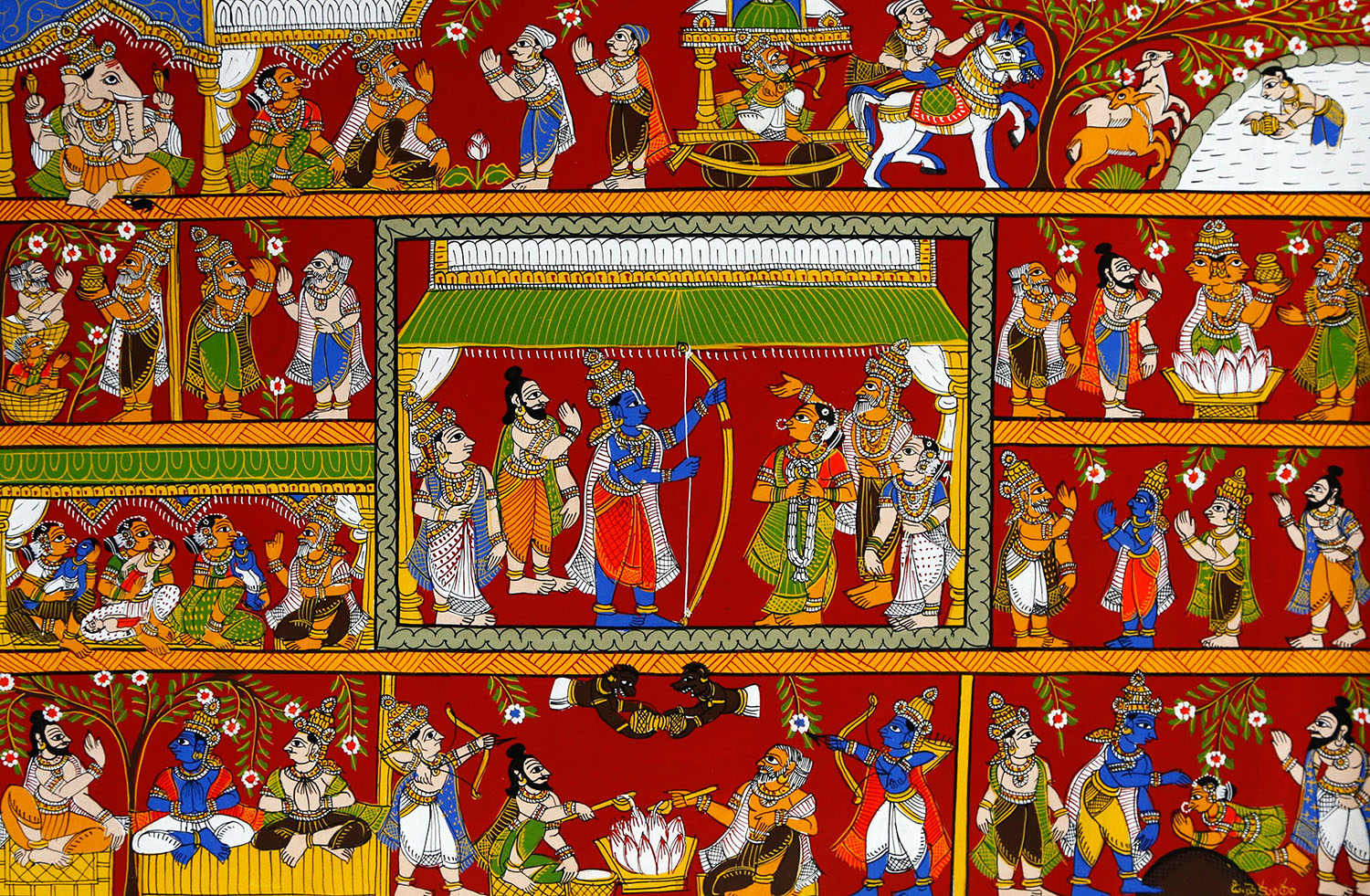
The stylized religious cloth-scroll paintings known as Cheriyal scroll paintings are full of Telangana-specific local elements. Currently, Hyderabad, Telangana, India is the only place they are manufactured.The scrolls, which show stories from Indian mythology and are closely related to the shorter stories from the Puranas and Epics, are painted in a narrative style like to a comic strip or film roll. In the past, similar paintings were common throughout Andhra and many other regions of the nation, but with unique styles and other regional quirks determined by regional traditions and customs. Similar to this, Cheriyal scrolls may have been common throughout Telangana in the past, but with the development of television, movie theaters, and computers, they were confined to their final bastion, the Cheriyal town. Patachitra and Phad are examples of textile scroll paintings that have a similar genesis to Cheriyal cloth-scroll paintings.
Hindu, Jain, and Buddhist writings all make reference to the ancient paintings known as Charanachitras, Mankhas, and Yamapatas, which were created on textile scrolls and dealt with narrative-didactic storytelling themes. In his book South Indian Paintings (2010), historian A. L. Dallaiccola claims that the first documented mention of textile-scroll paintings dates back to the second century BC in Mahabhashya. These cloth scroll paintings were utilized to educate "the principles ruling their religious and social life through the recitation of stories drawn from the epics, the puranas, and other religious texts," according to A.L. Dalloiccola..In the past, the uneducated were educated through the retelling of these stories, which were supported by visual aids such as painted fabric hangings, sets of paintings, wooden boxes with folding doors that resembled concertinas, and scenes painted on them. Additionally, pilgrims might purchase devotional scrolls as souvenir paintings to take home as a keepsake of their journey.

A contemporary Cheriyal Scroll painting
Medieval Era
With a history spanning over 400 years, the art form is tightly linked to the local storytelling customs. Depending on the local ethos, patronage, and socioeconomic circumstances, each Indian village and region established its own scroll painting traditions, which are distinguished by distinctive content, form, and technique. Pabuji ki Pad, Devenarayana Katha, and tales from the Dhola and Maru legends are among Rajasthan's most famous exports. Goa developed the Dasavathara, while Maharashtra developed the Chitra Katha and Pinguli traditions. Additionally, Maharashtra and Gujarat are renowned for the Prasasti Patra, a highly developed scroll painting style. Bengal and Orissa are well known for their Patachitra customs.
The Cheriyal scroll paintings and artists may have been greatly impacted by the aforementioned customs, but the Cheriyal paintings were and remain a uniquely Telangana-specific invention that primarily draws from local customs. It is possible to say that the main influences that formed and directed the art of scroll paintings were the graphic art traditions of the Deccan and South India in general, as well as the local temple art traditions and the Kalamkari tradition throughout the Golconda Sultanate. But it's also important to keep in mind that every scroll painting, including Cheriyal's, has a unique theme, area of activity, and creative style that is specific to the town or settlement.
The Nakashis were painters, while the Mandhets were Andhra Pradesh's traveling bards and entertainers. In addition to the painted scrolls, the Nakashis of Telangana also manufactured dolls, similar to the Karnataka Kinnal dolls. A significant component of Telangana's sociological and cultural context were these scrolls. These paintings are referred to as Cheriyal scrolls since they are cur
rently exclusive to Cheriyal village. In the past, the scrolls served as a vibrant backdrop for the equally fascinating oral traditions of the village's seven working and marginalized castes and communities: Madiga, Goud, Mudiraju, Malas, Padmashali, Chakala, and Mangali; the village's hajjam-barber, toddy tapper, dhobhi-washerman, chamar-leatherworker, fisherman, weaver, and farmer. The adventures and exploits of local folk heroes who performed on the periphery of the epics, Puranas, etc. of the Hindu "Greater Tradition" are described in the scrolls. Every community had its own unique characteristics, favorite heroes and heroines, and a variety of local mythological tales. In many groups, it was also common to sacrifice a goat following the reciting of the scroll's narrative.

Contemporary cheriyal dolls
Today the long stories from the local mythologies have been cut short, as the traditional patrons for the long scrolls no longer exist. The artists have been forced to adapt and nowadays they paint smaller versions of the scrolls, depicting a single episode or character from the traditional stories. These are amenable to framing and can be hung on walls in modern homes. Further, the colours are no longer prepared in the traditional manner. While earlier, they used natural white extracted from sea shells, black from lamp soot and yellow from turmeric.
The Tradition
Since there are no longer any traditional clients for the lengthy scrolls, the lengthy stories from the local mythology have been shortened. Due to their forced adaptation, the artists now create scaled-down copies of the scrolls that feature a single character or episode from the classic tales. These can be hung on walls in contemporary homes and are suitable for framing. Furthermore, the conventional method of preparing the colors has been abandoned. In the past, they used natural white made from sea shells, black made from lamp soot, and yellow made from turmeric. The scroll would resemble a roll of film. It varied in length from 40 to 45 feet, depending on the story, and was typically approximately three feet wide. Traditional scrolls often have a vertical format and use a sequence of horizontal panels to illustrate stories. The two panels are divided by a floral border in the center, and the linear story is illustrated by rolling it continuously while holding it in both hands or hanging it from a tree or structure. Each panel of the scroll represented a different aspect of the narrative, much like large-scale comic strips. A scroll may therefore easily contain about fifty panels. The panel showing that specific section of the story would be shown while the bard told the tale.

A traditional Cheriyal scroll painting depicting the legends of the toddy tapper community. Circa 18th - 19th century.
Recently, Cheriyal Paintings received a Geographical Indications (GI) classification because to its unique traditional style and features. The number of painters who still paint using this special method is quite small. Painting individual images for wall decorations rather than a continuous scroll is a contemporary invention.
Process
The process of creating the canvas is highly complex. A mixture of rice starch, suddha matti (white mud), a paste made from boiled tamarind seeds, and gum water is applied to the Khadi cotton three times. Prior to applying the next coating, it must be made sure that each one has completely dried. When the canvas is prepared, the artists use a brush to immediately sketch the outline on it. The skill and expertise of the craftsmen are clearly and sharply reflected in the contours. The artisans use natural materials to create the colors. Squirrel hair is attached to a stick and used to make brushes. Masks and dolls are fashioned from tamarind paste, sawdust, and wood. Even with coconut, masks are manufactured.

A modern Cheriyal painting in making
Characteristics
The following oddities and distinctive features make it simple to identify Cheriyal Paintings:
• The paintings are characterized by the unrestrained imagination of the local artisans, who were not bound by the academic rigor that characterized the more traditional Tanjore and Mysore paintings. They are painted in vivid hues, primarily primary colors, with a predominance of red in the background. In Cheriyal paintings, for instance, the artist scarcely pays attention to perspective and establishes the story by positioning the pertinent figures in the proper background and sequence. There is a strong local idiom in the iconography of even the great deities, such as Shiva and Vishnu.
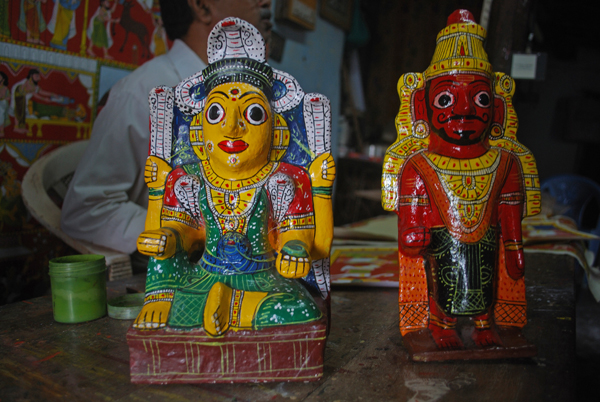
Contemporary cheriyal dolls
Because the topics and tales in these scroll paintings are well-known and derived from ancient literary, mythological, and folk traditions, it is simple to relate to the subjects. The Krishna Leela, Ramayana, Mahabharata, Shiva Puranam, Markandeya Puranam, and ballads and folktales from other communities, such as Gauda and Madiga, are intermingled with these common themes.
• Scenes from everyday rural life, such as women conducting household tasks in the kitchen, men working in the rice fields or drinking excessively, festival scenes, etc., are charmingly portrayed to liven up the main plot.
• The people are portrayed in surroundings and clothes that are typical of Andhra culture, which is where these paintings began.
Join our classes to enhance & improve your memory skills and let your child unlock the power to retain information from every moment of his/her life!
