
Collage Art
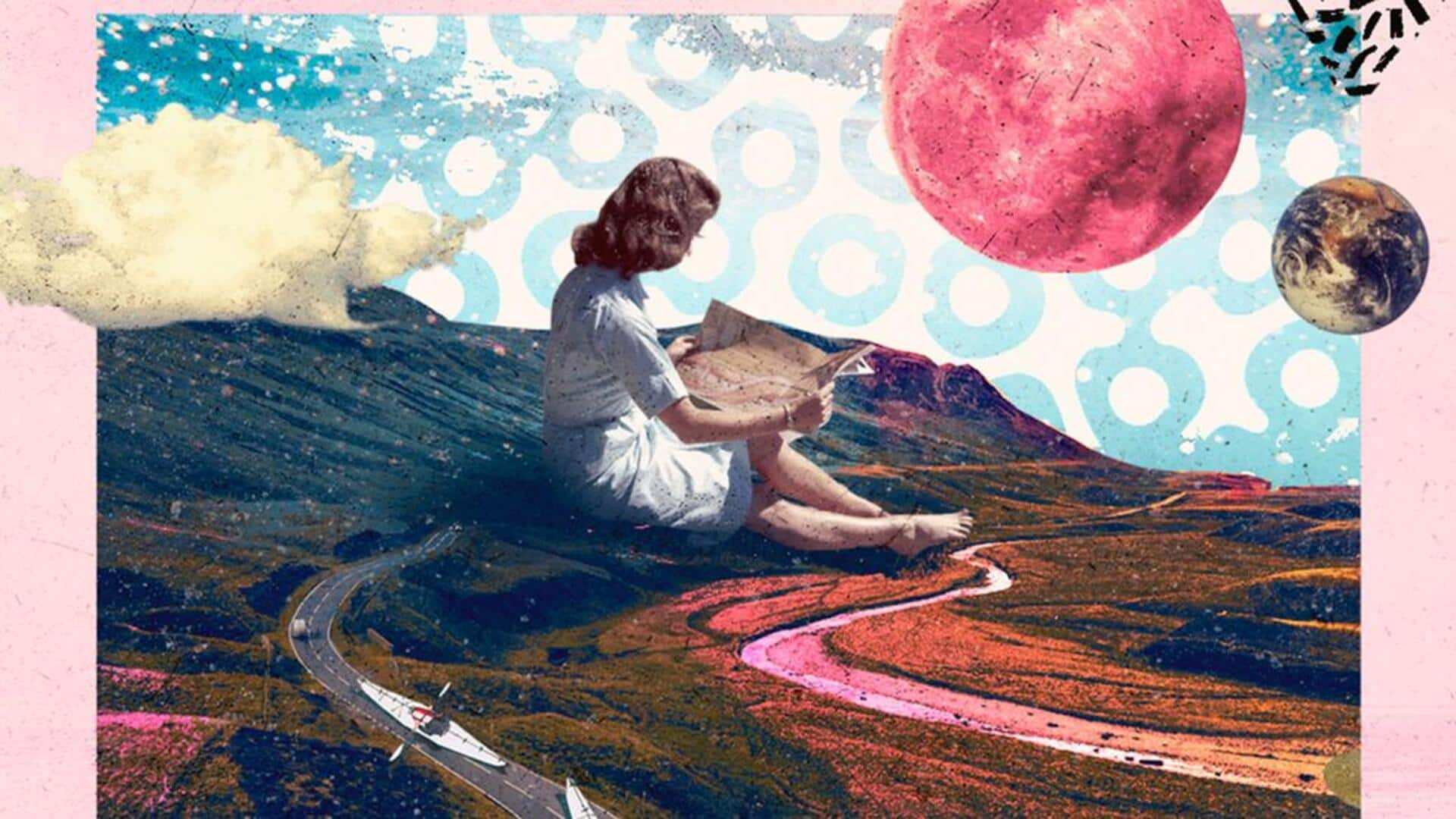
Collage is an art-making process that is mostly utilized in the visual arts. It creates a new whole by assembling disparate parts. Unlike assemblage, which usually refers to a three-dimensional version, collage can refer to the method as a whole or, more precisely, to a two-dimensional item put together from flat elements on a flat substrate.A collage can occasionally consist of newspaper and magazine clippings, ribbons, paint, pieces of handmade or colored paper, fragments of other artwork or text, photographs, and other discovered materials adhered to a piece of paper or canvas. Although collage's roots date back hundreds of years, the technique saw a major resurgence as a creative art form in the early 1960s. In the early 20th century, when collage emerged as a unique element of contemporary art, Pablo Picasso and Georges Braque both used the term "papier collage''.
Early precedents
The first records of paper collage date back to the tenth century in Japan, when calligraphers started composing their poems on pasted paper with text on surfaces. Numerous volumes of the Sanju Rokunin Kashu anthologies of waka poetry are part of the collection at the Nishi Hongan-ji temple, which also has some surviving works in this form.The use of gold leaf panels in Gothic churches began in the fifteenth and sixteenth centuries. Icons and religious representations were embellished with gemstones and other precious metals, as were coats of arms. The 18th century saw the creation of 985 botanical collages known as "flower Mosaicks" by Mary Delany, who started her collage career at the age of 72.

Kurt Schwitters, Das Undbild, 1919, Staatsgalerie Stuttgart
Throughout the 19th century, collage techniques were also used to literature (e.g., Hans Christian Andersen, Carl Spitzweg) and mementos (e.g., applied to photo albums). Many organizations have claimed that Picasso and Braque invented collage in 1912, although early Victorian photocollage indicates that collage methods were being used as early as the 1860s.Many institutions acknowledge these pieces as hobbyist memorabilia, but they also served as a means of facilitating communal portraiture of Victorian aristocrats, evidence of women's intelligence, and a new form of artistic representation that challenged the notion of truthfulness in photography. The exhibition Playing with Pictures was produced by curator Elizabeth Siegel at the Art Institute Chicago in 2009 to honor collage pieces by artists such as Mary Georgina Filmer and Alexandra of Denmark. A historically significant exhibition called Cut and Paste: 400 Years of Collage was displayed in 2019 at the National Galleries of Scotland. It included 250 pieces of paper, the oldest of which was a "flap anatomy" or "fugitive sheet" created in 1573.
Collage and modernism
Some art experts contend that collage, in its genuine sense, did not exist until after 1900, coinciding with the early phases of modernism, even if collage-like application techniques were used prior to the 20th century.

Hannah Höch, Cut with the Dada Kitchen Knife through the Last Weimar Beer-Belly Cultural Epoch in Germany, 1919, collage of pasted papers, 90x144 cm, Staatliche Museum, Berlin
The online art lexicon of the Tate Gallery, for instance, claims that collage "was first used as an artists' technique in the twentieth century." The online art lexicon of the Guggenheim Museum states that collage is an artistic concept that dates back to the early days of modernism and involves much more than just sticking something onto another object. When the glued-on patches "collided with the surface plane of the painting," Braque and Picasso's canvases adopted a new viewpoint on painting. The Guggenheim essay claims that these new pieces "gave each medium some of the characteristics of the other," that collage was a part of a systematic reexamination of the relationship between painting and sculpture. Additionally, the following shards of externally referenced meaning were introduced into the collision by these shredded newspaper pieces: "References to current events, such as the war in the Balkans, and to popular culture enriched the content of their art." The inspiration for collage was largely derived from this "at once serious and tongue-in-cheek" juxtaposition of signifiers: "By prioritizing concept and process over final product, collage has brought the incongruous into meaningful congress with the ordinary."
Collage in painting
Pablo Picasso and Georges Braque were the first Cubist painters to use collage in the modernist meaning. Cubism collages, or papier collé, looked and felt deconstructed because they were composed of bits and pieces of disparate and unrelated subject matter. Picasso was the first to employ the collage method in oil paintings, according to some authorities. The Guggenheim Museum's web site on collage claims that Braque adopted the collage concept before Picasso and used it in his charcoal works. Picasso embraced collage right once, and he might have been the first to employ collage in paintings rather than drawings. "Braque was the one who bought a roll of wallpaper with simulated wood grains and started cutting out pieces to adhere to his charcoal sketches. Picasso adhered an oilcloth patch featuring a chair-cane motif to the canvas of his 1912 Still Life with Chair Caning.

Pablo Picasso, 1913–14, Head (Tête), cut and pasted colored paper, gouache and charcoal on paperboard, 43.5 x 33 cm, Scottish National Gallery of Modern Art, Edinburgh
In addition to using collage extensively, surrealist painters have moved away from Cubists' emphasis on still life. Instead, surrealist painters like Joseph Cornell produced collages that featured fantastical and bizarre, dreamlike situations, in keeping with surrealism. Cubomania is a type of collage in which a picture is sliced into squares and then put back together either randomly or automatically. The collages created by Marcel Mariën employing a similar, or maybe same, technique are referred to as etrécissements. Mariën began the process. Parallel collage is one of the surrealist games that makes use of group collage techniques. Tom Wesselmann, Jim Dine, Robert Indiana, Roy Lichtenstein, Claes Oldenburg, James Rosenquist, George Segal, and Andy Warhol were among the American artists featured in the New Realist Exhibition, an early Pop Art exhibition held by the Sidney Janis Gallery in November 1962. European artists included Arman, Baj, Christo, Yves Klein, Festa, Mimmo Rotella, Jean Tinguely, and Schifano. It was the international debut of the artists who would later give rise to what became known as Pop Art in Britain and the United States and Nouveau Réalisme on the European continent. It came after the Nouveau Réalisme exhibition at the Galerie Rive Droite in Paris. Several of these painters employed collage techniques in their creations. With some reservations, Wesselmann participated in the New Realist exhibition.
Another method is canvas collage, which involves applying separately painted canvas patches to the main canvas of a painting, usually using adhesive. Although American artists like Conrad Marca-Relli and Jane Frank were already using canvas collage in their mixed-media works by the early 1960s, British artist John Walker is well-known for using this method in his paintings from the late 1970s. In addition to often destroying her own paintings by chopping them up into fragments, the fiercely critical Lee Krasner repeatedly put the fragments back together to make collages.
Wood Collage
After giving up painting in favor of paper collages, Kurt Schwitters started experimenting with wood collages in the 1920s. By the mid to late 1920s, he was making wood collage at least as early as his 'Merz Picture with Candle'. Cutting out pieces of imitation oak-grain wallpaper and affixing them to his own charcoal works was how Georges Braque first used paper collage.Because the paper used was a commercial product made to appear like wood, the concept of adhering wood to an image was therefore implied from the beginning of at least Cubist collage. By the mid to late 1920s, he was making wood collage at least as early as his 'Merz Picture with Candle'. Cutting out pieces of imitation oak-grain wallpaper and affixing them to his own charcoal works was how Georges Braque first used paper collage.Because the paper used was a commercial product made to appear like wood, the concept of adhering wood to an image was therefore implied from the beginning of at least Cubist collage.
Louise Nevelson developed her sculptural wood collages over the course of fifteen years of intense experimentation that started in the mid-1940s. These collages were put together from found scraps, such as furniture parts, pieces of wooden crates or barrels, and architectural remnants like moldings or stair railings. They are often very huge, rectangular, and painted black, giving them the appearance of enormous paintings. Nevelson's 1958 work Sky Cathedral is described in the Museum of Modern Art catalogue as having the pictorial character of a painting because it is a rectangular plane that may be seen from the front. Nevertheless, these components also seem as enormous monoliths or walls that are occasionally seen from both sides or even through.

Kurt Schwitters, untitled (Chessman), 1941, collage, oil, paper and wood on plywood
A lot of wood collage art is framed and hung like a painting, but it's much smaller in scale. Usually, it consists of wood fragments, wood shavings, or scraps that are put together on a wooden board or canvas (if painting is applied). These framed, picture-like, wood-relief collages give the artist a chance to work with the material's inherent qualities of depth, natural color, and textural variety while utilizing the language, conventions, and historical resonances that come from the tradition of making wall-mounted pictures. Wood collage is also occasionally used in conjunction with painting and other media to create a single piece of art. A lot of the time, "wood collage art" is made entirely of natural wood, like driftwood or pieces of found, untouched logs, branches, sticks, or bark. Whether such artwork is collage (in the original sense) is called into question by this (see Collage and Modernism). This can be attributed to the fact that early paper collages were typically composed of text or images that were created by individuals and served a cultural purpose. Through a sort of semiotic collision, the collage brings these still-recognizable "signifiers" (or pieces of signifiers) together. In the same way that it had some unique, culturally driven context, a shortened wooden chair or staircase newel utilized in a Nevelson piece may likewise be seen as a potential collage element.
Decoupage
Decoupage, sometimes called Découpage in French (from the verb découper, which means "to cut out"), gained enormous popularity in the 17th and 18th centuries. This period saw the development of several sophisticated processes, and because of the numerous coats and sandings that were required, things may take up to a year to finish. Among the well-known or aristocratic practitioners were Beau Brummell, Madame de Pompadour, and Marie Antoinette. Actually, most proponents of decoupage believe that the practice originated in Venice in the 17th century. However, Asia was aware of it before to this period.
Decoupage is believed to have originated most likely from East Siberian burial art. The tombs of their dead were decorated by nomadic tribes using cutout felts. The custom originated in Siberia and spread to China, where it was employed to adorn lanterns, windows, boxes, and other items by the 12th century. Italy, particularly Venice, was a major trading hub with the Far East in the 17th century, and it is generally believed that these connections are how cutout paper decorations entered Europe. Artists who practiced decoupage started experimenting with a less realistic and more abstract manner in the early 20th century. Artists from the 20th century, such as Henri Matisse and Pablo Picasso, created decoupage pieces.
Photomontage
Photomontage is a type of collage created from images or portions of photographs. The method (and outcome) of creating a composite image by combining and editing several different images is called photomontage. Occasionally, the composite image was captured with the intention of converting the end product back into a seamless photographic print. Today, the same technique is carried out with image-editing software. Professionals call this method "compositing." The hand-colored photo collage was one of the collage and photomontage techniques that photographer and poet Kansuke Yamamoto experimented with in Japan in the 1930s. Photographic pictures and newspaper clippings are combined in The Developing Thought of a Human … Mist and Bedroom (1932).

Grete Stern, Sueño No. 28: Love without Illusion, 1951, gelatin silver print
Richard Hamilton made the collage captioned "Just what is it that makes today's homes so different, so appealing?" in 1956. It was reproduced in black and white for the catalogue of the This Is Tomorrow exhibition in London, England. Additionally, posters for the exhibit included the piece. Since then, Richard Hamilton has produced a number of pieces in which he altered the pop art collage's theme and composition, such as a 1992 version that included a female bodybuilder. In press photography and offset lithography, the 19th-century practice of physically combining several images into a composite and taking pictures of the finished product predominated until the widespread adoption of digital image manipulation. These days, photo editors in publications make "paste-ups" using computer technology.
Generally speaking, the introduction of computer programs like Adobe Photoshop, Pixel image editor, and GIMP has made photomontage creation simpler. These systems use digital technology to make the adjustments, which enables a quicker workflow and more accurate outcomes. Additionally, they lessen errors by enabling the artist to "undo" mistakes. However, some artists are competing with the demands of the traditional arts by pushing the limits of computer image manipulation to produce incredibly time-consuming compositions. Producing images that seamlessly integrate painting, theater, illustration, and graphics is currently popular.
"Black Collage"
The first well-known Black artist to show interest in collage in the United States is Romare Bearden, who experimented with W.E.B. DuBois' idea of "double consciousness" in the 1960s using collage, and more precisely "photomontage," according to the African American art historical tradition. In response to the political actions of the Black Power Movement and the Civil Rights Movement, Bearden created the Spiral Group, a group of Black artists in New York City that came together soon after the August 1963 March on Washington for Jobs and Freedom, and used collage techniques in both his professional work as an artist and as a mode of sociality. The growth of extreme Black aesthetics during the Black Arts movement was greatly aided by organizations like as Spiral, despite the fact that they were eventually unsustainable. In response to the political actions of the Black Power Movement and the Civil Rights Movement, Bearden created the Spiral Group, a group of Black artists in New York City that came together soon after the August 1963 March on Washington for Jobs and Freedom, and used collage techniques in both his professional work as an artist and as a mode of sociality. The growth of extreme Black aesthetics during the Black Arts movement was greatly aided by organizations like as Spiral, despite the fact that they were eventually unsustainable.
Many African American "artists worked in styles in the cubist tradition" during and after the official dissolution of the BAM, as Patricia Hills explains in "Cultural Legacies and the Transformation of the Cubist Collage Aesthetic by Romare Bearden, Jacob Lawrence, and Other African American Artists." This may have been because of a clear resonance between blackness and "the structure of collage cubism, which gives parity to the shapes of both forms and spatial intervals."Since the exhibition Multiplicity: Blackness in Contemporary American Collage moved to several sites throughout the United States between 2023 and 2024, the category "Black Collage" has received more notice.
Join our classes to enhance & improve your memory skills and let your child unlock the power to retain information from every moment of his/her life!
