
Gond Art
/12_04_2022/Gond-Art-Orange-Deer-14x15.jpg)
The Gond have established numerous important kingdoms throughout history. In the Gondwana region of India, Gondwana was the dominant kingdom. This covers the eastern portion of Maharashtra's Vidarbha. Parts of western Chhattisgarh and Madhya Pradesh immediately to the north are included in the Garha Kingdom. Beyond these, portions of southern Uttar Pradesh, western Odisha, and northern Telangana are included in the larger region.
It is said that the Telugu language is related to Gondi. About 2.4 million people speak Gondi as a macrolanguage and 2.91 million speak languages within the Gondi subgroup, including Maria (also known as Maadiya Gond), according to the 2011 Indian Census.Additionally, a large number of Gonds speak Telugu, Odia, Marathi, Hindi, and other regional languages. As per the 1971 census, there were 5,653,422 people living in Gondi. This rose to 7,300,998 by 1991, and 8,501,549 by 2001. The group has witnessed the Naxalite-Maoist insurgency for the past few decades. To combat the Naxalite insurgency, the Gondi people organized the Salwa Judum, an armed militant group, at the Chhattisgarh government's request. On July 5, 2011, the Supreme Court of India issued an order dissolving this, although.
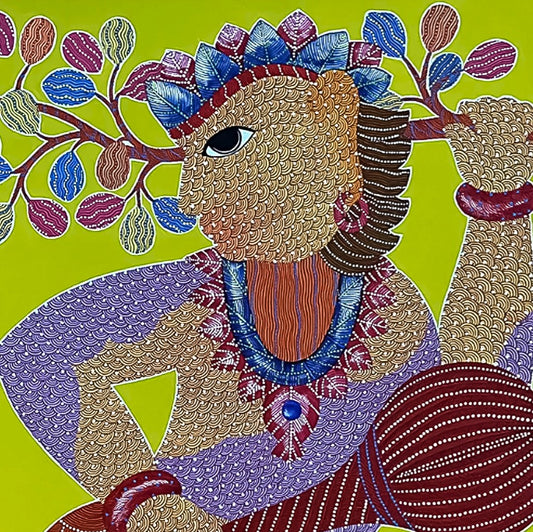
Orange Deer
The Gonds call themselves Koitur (Kōītōr) or Koi (Kōī), which also has no definitive origin but is perhaps related to kō, meaning "mountain", other ethnonyms like Kui, Kuvi, koya and Kubi (Konda endonym) are also said to be from it.The Gonds refer to themselves as Koitur (Kōītōr) or Koi (Kōī), which may be related to kō, which means "mountain." Other ethnonyms such as Kui, Kuvi, Koya, and Kubi (Konda endonym) are also thought to derive from it.
History
It is unknown where the Gonds came from. According to some researchers, the Gonds were a group of diverse tribes that spoke several pre-Dravidian languages before adopting a proto-Gondi language as their mother tongue from a class of rulers. Although there is a connection between Gonds and Munda peoples, academics support different beginnings for these two groups by pointing to a more complicated occurrence including language transfer through a Dravidian linguistic expansion rather than a recent event of Gondi replacing a North Munda language.
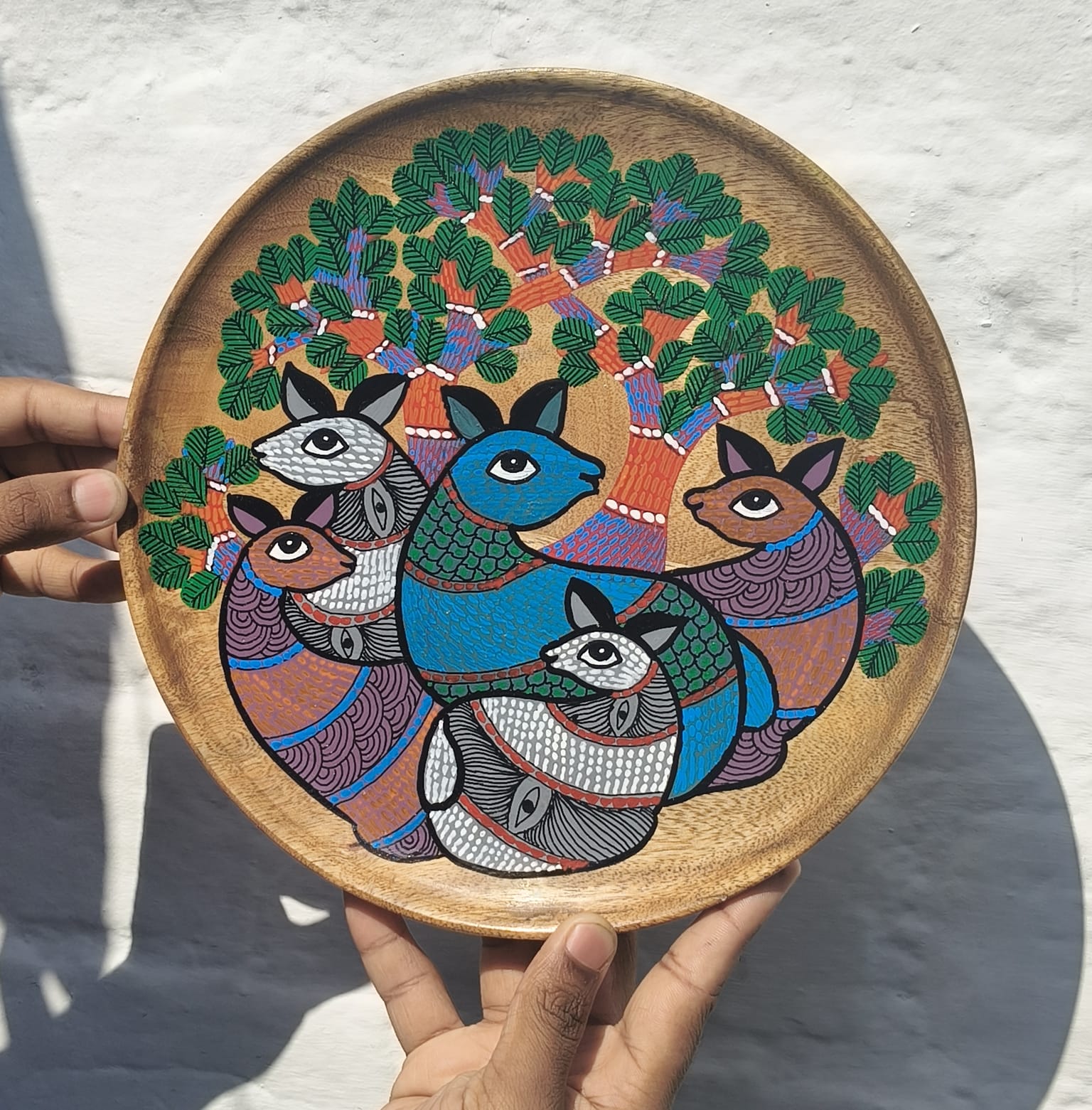
According to R. V. Russell, the Gonds entered Gondwana from the south, first up the Godavari into Vidarbha, then up the Indravati into Bastar, and finally up the Wardha and Wainganga into the Satpura Range.
Muslim sources from the fourteenth century include the earliest known mention of the Gonds. Between the 13th and the 19th centuries CE, the Gonds are thought to have controlled Gondwana, which stretched from northern Telangana to the southeast corner of Uttar Pradesh and from modern-day eastern Madhya Pradesh to western Odisha.
Although some lineages date its beginnings back to the ninth century CE, Chanda was the first kingdom of the Gonds, established around 1200. Originating from Sirpur in what is now northern Telangana, the Gonds of Chanda are credited with overthrowing the Mana dynasty, the nation's previous rulers.
According to a different account, the Gonds of Sirpur had the chance to resist external rule and establish their own kingdom following the collapse of the Kakatiyas in 1318. The earliest well-defined income system among the Gond kingdoms was established in the kingdom of Chanda, along with significant irrigation. Additionally, it started constructing forts, which eventually developed into extremely complex structures. Chandrapur was established by Khandakhya Ballal Shah, who moved the capital from Sirpur to the town. The kingdom was completely independent, according to the Ain-i-Akbari, and it even overran some neighboring sultanates. However, as the Mughals incorporated land to their south into the Berar Subah, Babji Shah started paying tribute during Akbar's reign.
After overthrowing the previous Kalachuri rulers, Jadurai established the kingdom of Garha in the fourteenth century. Queen Rani Durgavati of Garha-Mandla is well-known for her battles against the Mughal emperor Akbar (d. 1564). Bir Narayan, her son, took over as ruler of Mandla and continued to fight till his death. Chanda Shah was then presented with his kingdom by the triumphant Mughals. Hirde Shah, Shah Jahan's successor, moved the capital to Mandla after being invaded by the Bundelas. His successors battled against themselves and enlisted Aurangzeb and the Marathas to support them.
Deogarh was established in the early thirteenth century. During a temple ceremony, its founder, Jatba, is supposed to have killed the previous Gauli monarchs [by whom?]. According to the Ain-i-Akbari, Deogarh had 50,000 foot soldiers, 2,000 cavalry, and 100 elephants under the leadership of a king called Jatba. Jatba established outposts, including a fort close to present-day Nagpur, in the Berar plains. In order to gain Aurangzeb's support, his grandson Bakr Shah became Bakht Buland Shah after converting to Islam. Shah restored prosperity back to the Deogarh kingdom and established the city of Nagpur. During his rule, the kingdom included portions of the northern Berar plains and the southeast Satpura range from Betul to Rajnandgaon in the east.The kingdom included portions of the northern Berar plains and the southeast Satpura hills from Betul to Rajnandgaon in the east during his rule. Nagpur became much more significant under his son Chand Sultan.

After the Mughals briefly overran these kingdoms, the Gond rajas were eventually reinstated and merely came under Mughal suzerainty. When the Marathas started attacking the Gond rajas in the 1740s, both subjects and rajas fled from the plains to the hills and forests. Garha-Mandla's Gond rajas were compelled by Raghoji Bhonsle to pay homage to him. The displaced indigenous population was swiftly replaced by Marathi caste groups. Up to the Third Anglo-Maratha War, when the British seized control of the last Gond zamindaris and assumed revenue collection, the Marathas occupied the Gond rajas' domain.
The Gonds were disadvantaged by colonial forest management techniques under colonial control. The 1910 Bastar insurrection, also referred to as the bhumkal in the tribal belt, was a partially successful military uprising against colonial forest policies that prevented the Madia and Muria Gonds of Bastar, as well as other tribes in the area, from accessing the forest for their means of subsistence. A Gond leader from Adilabad in Hyderabad state named Komaram Bheem rebelled against the Nizam and demanded a separate Gond raj at the beginning of the 1920s. The famous catchphrase jal, jangal, jameen ("water, forest, land") that has represented Adivasi movements since independence was created by him.
The Gond Mahasabha was established in 1916 by Gondi intellectuals from different regions of Gondwana in order to defend Gondi culture against growing external influence. The organization met in 1931 and 1934 to talk about social values that Gonds should adhere to, measures to protect Gond culture from foreign interference, and unity among Gonds in various regions of Gondwana. Beginning in the 1940s, a number of Gond leaders promoted the creation of a distinct state that would include the former Gondwana territory, particularly the tribal regions of eastern Madhya Pradesh, Chhattisgarh, Vidharbha, and Adilabad.
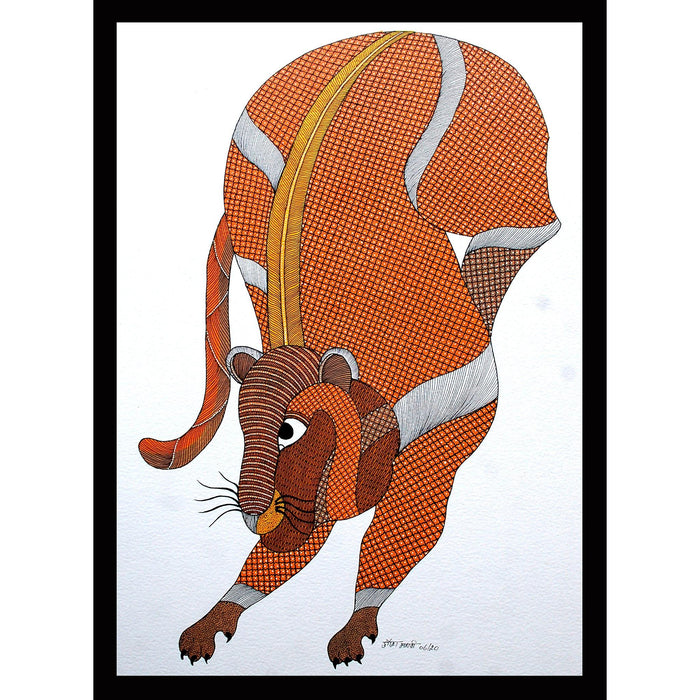
Gond Painting on Handmade Paper of Bagh Baghwa
When Heera Singh established the Bharatiya Gondwana Sangh to push for statehood in the early 1950s, the demand peaked. Singh was able to mobilize 100,000 people between 1962 and 1963 and had numerous meetings throughout Gondwana, but by the late 1960s, his campaign had faded and the Indian government had never taken it seriously. The state disregarded other forms of protest, including as petitions and demands made by different Gond organizations. In order to struggle for statehood, Heera Singh Markam and Kausalya Porte created the Gondwana Ganatantra Party in the 1990s. The Gond rajas, who were influenced by the Rajputs and Mughals, went by the titles Singh or Shah. They are also referred to as the Raj Gond.
Join our classes to enhance & improve your memory skills and let your child unlock the power to retain information from every moment of his/her life!
