
Indigenous Australian art
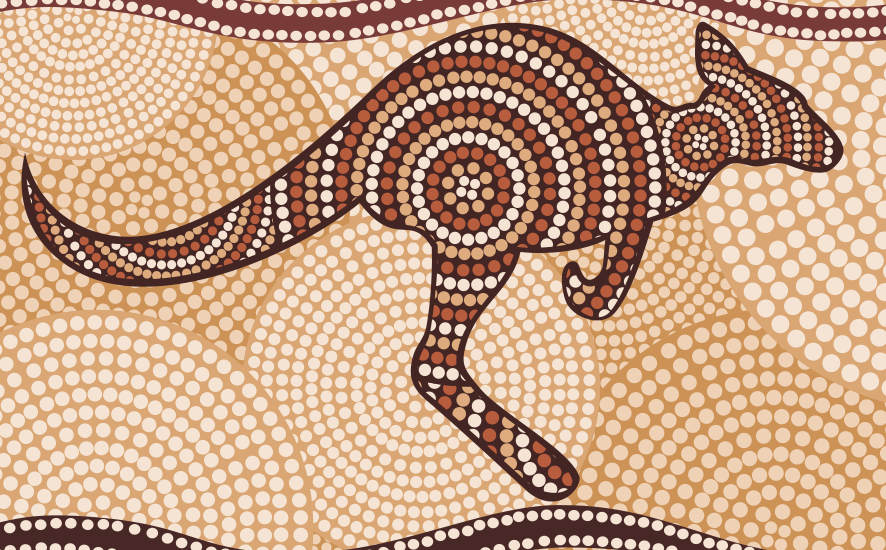
Art created by Aboriginal Australians and Torres Strait Islanders, including joint projects, is referred to as Indigenous Australian art. Paintings on leaves, bark, wood, rock, watercolor, sculpture, ceremonial apparel, and sandpainting are just a few of the many mediums that are shown. Despite the widespread misconception that dot painting is indicative of all Aboriginal art, the traditional visual symbolism varies greatly among the many peoples' traditions. Rock painting, dot painting, rock engravings, bark painting, carvings, sculptures, weaving, and string art are just a few of the various forms and techniques utilized to create Aboriginal art. The world's oldest uninterrupted artistic heritage is seen in Australian Aboriginal art. aintings on leaves, bark, wood, rock, watercolor, sculpture, ceremonial apparel, and sandpainting are just a few of the many mediums that are shown. Despite the widespread misconception that dot painting is indicative of all Aboriginal art, the traditional visual symbolism varies greatly among the many peoples' traditions. Rock painting, dot painting, rock engravings, bark painting, carvings, sculptures, weaving, and string art are just a few of the various forms and techniques utilized to create Aboriginal art. The world's oldest uninterrupted artistic heritage is seen in Australian Aboriginal art.

Gwion Gwion rock art found in the north-west Kimberley region of Western Australia
Stone Art
There are locations all around Australia where rock art, such as painting, etching, or carving (petroglyphs), can be found. There are examples of rock art that are said to show both more recent historical events, such the advent of European ships, and extinct megafauna from the Pleistocene era, like Genyornis and Thylacoleo. The Pilbara region of Western Australia and the Olary district in South Australia are thought to have the oldest rock art, which dates back up to 40,000 years. A charcoal drawing on a tiny rock fragment discovered during the excavation of the Narwala Gabarnmang rock shelter in southwest Arnhem Land in the Northern Territory is the earliest conclusively dated example of rock art painting in Australia. With a proven date of 28,000 years, it is among the earliest known works of rock art on Earth. Although the original motif's shape is uncertain, it is believed that this ornamented fragment may have originally been a component of a bigger ceiling artwork.
A massive painting of a macropod from a rock shelter in the Kimberley region of Western Australia is the oldest unambiguously dated, in-situ rock art theme in Australia. It was radiometrically dated in February 2021 to be roughly 17,300 years old.Originally named after Joseph Bradshaw, who first documented them in 1891, Gwion Gwion rock art (also known as the "Bradshaw rock paintings" or "Giro Giro") is a collection of rock drawings on caves in Western Australia's Kimberley region. A 2020 study estimates the age of this artwork to be around 12,000 years.

Pictographs known as Wandjina in the Wunnumurra Gorge, Barnett River, Kimberley, Western Australia
Paul Tan supervised a study that documented the Maliwawa Figures, which were published in Australian Archaeology in September 2020. The artwork comprises 572 photos from 87 locations in northwest Arnhem Land, ranging from the Wellington Range to the Awunbarna (Mount Borradaile ) area. It is assumed that they were created between 6,000 and 9,400 years ago. The discovery is said to be extremely uncommon in terms of style as well as the earliest known representation of a dugong and a depiction of bilbies, which are not known historically in Arnhem Land. Prior to this investigation, the artwork—all paintings in a naturalistic manner and ranging in color from red to mulberry, with the exception of one drawing—had not been documented in the literature.They are big and show human-animal relationships—a motif that is uncommon in rock art. In Arnhem territory, dugongs, thylacines, and bilbies have been extinct for thousands of years. The artwork was initially observed by researchers in 2008–2009, but it was only examined in fieldwork conducted between 2016 and 2018. Ronald Lamilami, a senior traditional owner, named the figurines.
"The Maliwawa back-to-back figures are the oldest known for western Arnhem Land, and it appears that this painting convention began with the Maliwawa style," says Tacon. It has continued to the present with bark paintings and paintings on paper." Taň compares the Maliwawa Figures to George Chaloupka's Dynamic Figures style, in which 42% of the subject matter is human, compared to approximately 89% in the Maliwawa Figures. Regarding the categorization of rock art styles in Arnhem Land, however, there is a great deal of disagreement and complexity. Depending on the kind of rock being utilized and other variables, different techniques are used to produce petroglyphs, also known as rock engraving. Australia is home to many different kinds of rock art, the most well-known of which being the Panaramitee rock art in Central Australia, the Murujuga in Western Australia, and the Sydney rock carvings surrounding Sydney in New South Wales. The Toowoomba engravings, which feature carved persons and animals, have a distinct style that is unique to Australia.

Aboriginal rock painting at Namadgi National Park featuring a kangaroo, dingoes, emus, humans and an echidna or turtle
Images of extinct creatures like the thylacine can be found in the rock engravings at Murujuga, which are thought to be the greatest collection of petroglyphs in the world .Activity is documented from before the last ice age to colonization. William Westall (1803) Chasm Island, a native cave painting. On January 14, 1803, Aboriginal rock drawings were discovered for the first time in Europe. British navigator and explorer Matthew Flinders landed on Chasm Island while on a surveying mission across the islands and coastlines of the Gulf of Carpentaria.Flinders observed a variety of painted and stenciled patterns among the island's rock shelters. He recruited William Westall, the ship's artist, to capture these pictures. The earliest known examples of Australian rock art are two watercolor studies by Westall.
Stone arrangements
Australian Aboriginal people create a type of rock art known as "Aboriginal stone arrangements." They are usually made up of stones, each around 30 cm in size, arranged in a pattern that spans several to tens of meters. Many of the stones have "trigger-stones" to sustain them, and they are all firmly embedded in the ground. The state of Victoria is home to some really beautiful examples, some of which have enormous stones. For instance, the Wurdi Youang stone arrangement is made up of roughly 100 stones arranged in an oval shape that is about 50 meters (160 feet) across. The site's appearance resembles the megalithic stone circles that can be found all throughout Britain, despite the fact that its purpose and culture are probably entirely different.

William Westall (1803) Chasm Island, native cave painting, 1803, watercolour
Its purpose is unknown, though it may be related to initiation rites, despite its undeniable and well-established association with Aboriginal Australians. The possibility that the location was utilized for astronomical reasons has also been proposed. Smaller stone arrangements that accurately represent the praus used by Macassan Trepang fishers and spear throwers may be found all throughout Australia, such as those close to Yirrkala.
Wood carvings
Aboriginal culture has historically relied heavily on wood carving, which requires fire, wire, sharp stones, and wood. Patterns on the object were created by heating the wire with fire and laying it on the wood carving. Erlikilyika, a Central Australian artisan, created animal-shaped wood carvings that were occasionally exchanged for products with Europeans. Aboriginal people created wood carvings in order to convey their Dreaming stories, their group's heritage, and important details about their nation and traditions. Ceremonies like the ilma also made use of them. Pukumani grave posts were customarily crafted by Aboriginal people from the Tiwi Islands.
Bark Painting
An ancient custom is bark painting, which involves applying ochres to dried bark that has been removed from trees. Other painted bark shelters were discovered in Victoria and New South Wales, with the first European discovery occurring in a shelter in Tasmania circa 1800. After being sketched with charcoal, these were painted or scraped onto smoke-blackened bark. Bark coffins and belts were painted in northeastern Arnhem Land, and painted bark baskets were utilized in funeral rites in the Melville and Bathurst Islands. Even now, bark painting is still practiced. In Northern Australia, particularly in Arnhem Land, bark painting techniques include x-ray style and cross-hatching, also known as bark.
Symbols and sacred aspects
While the meaning of some symbols within the Aboriginal modern art movement may vary depending on the painting's context, some symbols have the same meaning throughout different locations. When viewed in monochrome, additional symbols can appear similar, such as circles within circles, which are sometimes represented alone, sparingly, or in clusters. Aboriginal painters frequently use an aerial viewpoint in their paintings, such as those depicting a Dreaming story. The story is told from the perspective of the land as it was formed either during creation or by ancestral beings on their journey. The music, ceremonies, rock art, body art, and ceremonies (like awelye) that were common for many thousands of years have been reinterpreted in the contemporary version.
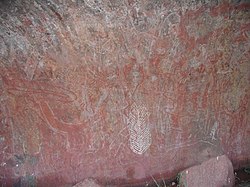
Aboriginal art at Uluru
Regardless of the significance, readings of the symbols should take into account the painting's overall context, the artist's home region, the painting's backstory, and its style. Aboriginal people consider some natural locations to be sacred, and they frequently perform seasonal ceremonies there. During these ceremonies, the Aboriginal people painted and engraved rocks, made feather and fiber things, and painted on the bark of Eucalyptus tetrodonta trees. All Aboriginal peoples share the Dreaming, also known as Jukurrpa, although stories varied among clans, linguistic groupings, and larger groups. According to these beliefs, mythic Aboriginal ancestor spirits created the land and sky in the past and eventually assimilated into it. The spiritual beliefs of the Aboriginal peoples provide the basis of their ceremonies, laws, and artistic expressions. There is nearly always a mythological undertone connected to the Dreaming in traditional Aboriginal art.
Traditional cultural expressions
The UN Declaration on the Rights of Indigenous Peoples and the Intergovernmental Committee on Intellectual Property and Genetic Resources, Traditional Knowledge and Folklore of the World Intellectual Property Organization (WIPO) define indigenous knowledge as both traditional knowledge and traditional cultural expressions. WIPO defines "traditional cultural expressions" as "any form of artistic and literary expression in which traditional culture and knowledge are embodied." These include ceremonies, stories, folklore, paintings, and handcrafted fabrics that are passed down from one generation to the next. "The use of the word 'traditional' tends not to be preferred as it implies that Indigenous culture is locked in time" according to Indigenous Australian communities.
Vandalism and other threats
Numerous culturally and historically significant Aboriginal rock painting sites have deteriorated over time due to encroachment by early settlers and contemporary visitors (including erosion from excessive touching); clearing for industrial development; and wanton vandalism and graffiti in criminal acts of destruction. Below are a few recent examples. Unique 30,000-year-old artwork at Koonalda Cave on the Nullarbor Plain in South Australia, which had been heritage-listed in 2014 because to its rarity, was vandalized in 2022 and much of it was rendered unrecoverable in an incident that made headlines worldwide. The Mirning people placed a lot of importance on the location.
In order to construct a new fertilizer factory, three huge rock art panels were taken out of Murujuga, Western Australia, in 2023. A number of archaeologists have called on others to join the voices of Aboriginal people in opposing this kind of harm to cultural sites. The Bulgandry Aboriginal art site in Brisbane Water National Park, an old Aboriginal art site in New South Wales, was vandalized twice in a matter of months between late 2023 and early 2024. In an effort to stop additional damage, NSW National Parks and Wildlife Service erected signage, mounted surveillance cameras, and closed off one walking pathway to the location.
Modern Aboriginal artists
Albert Namatjira, an Indigenous man living at Hermannsberg Mission, southwest of Alice Springs, was taught to watercolor painting in the 1930s by artists Rex Battarbee and John Gardner. He became the first Indigenous Australian watercolorist as well as the first to successfully exhibit and sell his works to the non-Indigenous community after his landscape paintings, which were originally produced in 1936 and displayed in Australian towns in 1938, were instantly popular. Other Indigenous artists in the area, starting with his close male relatives, took up Namatjira's technique of painting, and they came to be known as the Arrernte Watercolourists or the Hermannsburg School. The National Gallery of Australia in Canberra revealed the Aboriginal Memorial in 1988. It was constructed from 200 hollow log coffins, which are comparable to those used for funeral rites in Arnhem Land. It was created to commemorate the bicentennial of Australia's colonization and to honor the Aboriginal people who lost their lives defending their territory during hostilities with Europeans. It was produced by forty-three artists from Ramingining and surrounding areas.

Picture of Albert Namatjira at the Albert Namatjira Gallery, Alice Springs Cultural Precinct, in 2007
Emily Kngwarreye, from the Utopia hamlet north east of Alice Springs, rose to prominence in the late 1980s and early 1990s with her paintings. Her yearly fashion changes have been perceived as a blend of modern Australian and traditional Aboriginal fashions. Many Indigenous artists from central, northern, and western Australia, including her niece Kathleen Petyarre, Angelina Pwerle, Minnie Pwerle, Dorothy Napangardi, and many more, have seen their rise in prominence precede hers.
Join our classes to enhance & improve your memory skills and let your child unlock the power to retain information from every moment of his/her life!
