
Landscape painting

The depiction of natural scenery, such as mountains, valleys, rivers, trees, and woods, in painting, especially when the primary subject is a broad view—with its components grouped into a cohesive composition—is referred to as landscape painting, or landscape art. Landscape backdrops for figures can nevertheless play a significant role in other pieces. The weather is frequently incorporated into the composition, and the sky is nearly always featured in the view. Not all creative traditions include detailed landscapes as a separate subject; instead, they emerge when a sophisticated practice of depicting other subjects already exists. Western painting and Chinese art both have two major traditions that date back more than a millennium. The acknowledgement of a spiritual component in landscape painting dates back to East Asian art, which draws from Daoism and other intellectual traditions. However, Romanticism is the only movement in the West that makes this explicit. Artistic depictions of landscapes might be wholly made up or accurately replicated from reality. A image is referred to as a topographical view if its main objective is to portray a real, specific location, especially one that prominently features buildings. Although the disparity is not often significant, such opinions—which are as prevalent as prints in the West—are frequently perceived as inferior to high art landscapes; comparable prejudices existed in Chinese art.
Around the beginning of the 17th century, the word "landscape" entered the modern English language as landskip (variously spelled), an anglicization of the Dutch landschap, solely as a term for artistic creations; it was first used in 1598 to refer to a painting. It was eventually adopted as a phrase for actual views after being used to characterize vistas in poetry within a few decades. Although it is not documented from Middle English, the cognate term "landscaef" or "landskipe" meaning a cleared area of land existed in Old English.
History
Although ground lines and occasionally hints of mountains, trees, or other natural characteristics are depicted, there isn't much that could be considered a landscape among the oldest forms of art produced worldwide. Minoan frescoes from around 1500 BCE are the oldest examples of "pure landscapes" devoid of human forms. A strong sense of place can be created by hunting scenes, particularly those from Ancient Egypt that take place in the enclosed view of the Nile Delta's reed beds. However, the focus is more on the individual plant shapes and human and animal figures than the entire landscape backdrop. One well-known example is the frescoes from the Tomb of Nebamun (c. 1350 BC) that are currently housed in the British Museum.
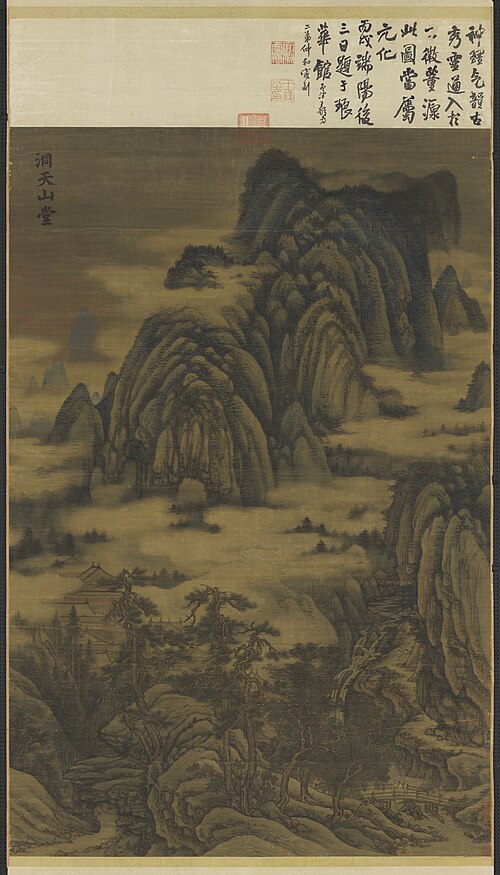
Dong Yuan (934–962) Dongtian Mountain Hall (Chinese: 洞天山堂圖). 10th century, the Five Dynasties (Chinese). National Palace Museum, Taipei.
From the first century BCE onward, more ancient Roman landscapes have been preserved, particularly mosaics and frescoes depicting landscapes that adorn rooms at Pompeii, Herculaneum, and other archeological sites. The Chinese ink painting tradition of shan shui ("mountain-water"), or "pure" landscape, in which the only indication of human life is typically a sage or a glimpse of his hut, employs intricate landscape backgrounds to figure subjects. This era's landscape art is still regarded as classic and frequently imitated within the Chinese tradition. Both the Roman and Chinese traditions frequently depict expansive vistas of made-up landscapes, usually surrounded by a variety of breathtaking mountains; in China, these landscapes frequently have waterfalls, whereas in Rome, they frequently feature rivers, lakes, or the sea. These were often employed, as in the example shown, to fill in the gap between a far-off panoramic view and a foreground scene with figures, a recurring issue for landscape painters. In order to get around that problem, the Chinese style typically only displayed a far-off perspective or made use of mist or dead terrain. One significant difference between landscape painting in the West and East Asia is that, up until the 19th century, it held a low place in the recognized hierarchy of genres in the West, whereas in East Asia, the traditional Chinese mountain-water ink painting was considered the most prestigious type of visual art. Both regions' aesthetic conceptions placed the most value on the pieces that were seen to demand the artist's greatest creativity.
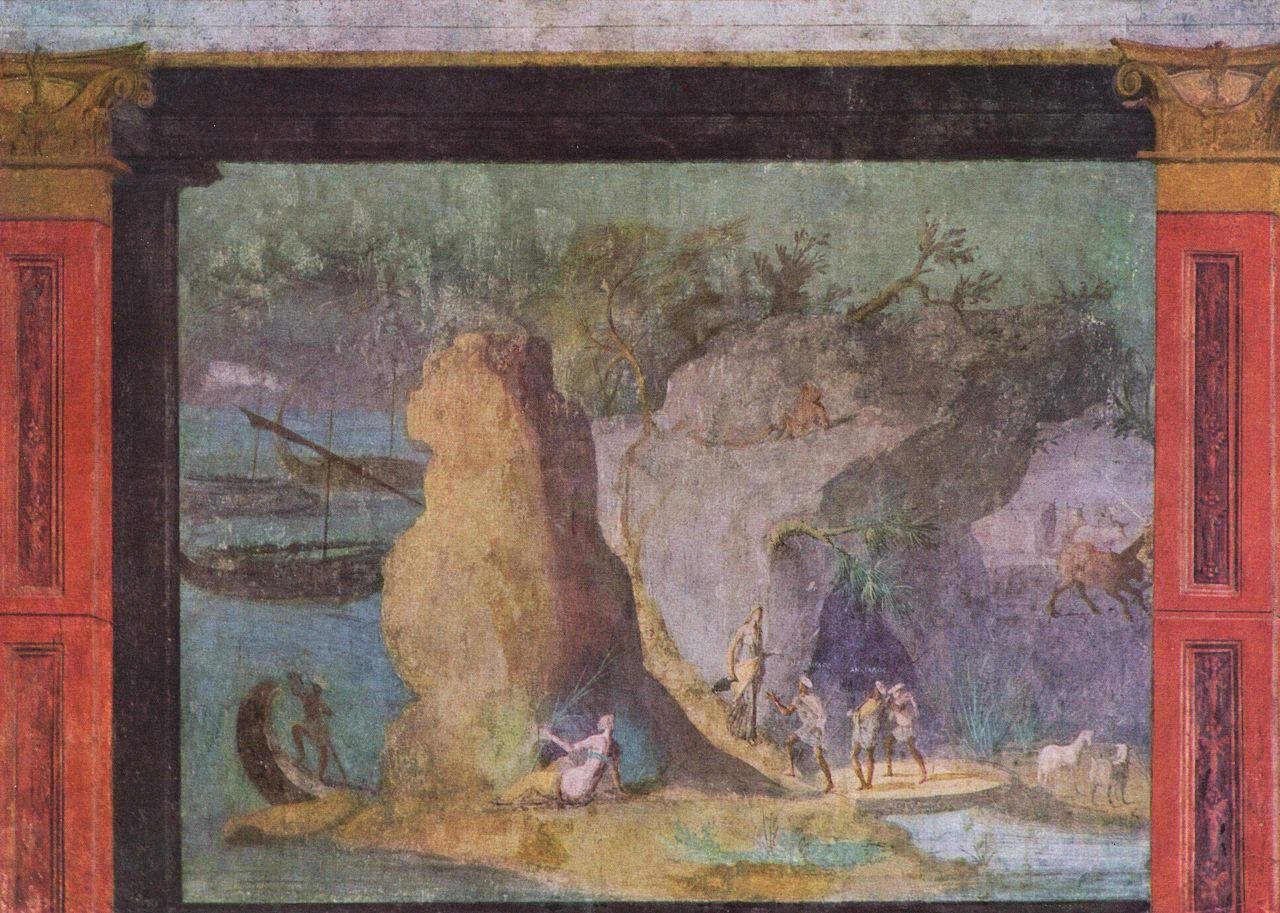
Landscape with scene from the Odyssey, Rome, c. 60–40 BCE
In the West, this was the painting of history, while in East Asia, it was the painting of an imaginary landscape. Prominent practitioners, including several Chinese and Japanese emperors, were, at least in theory, amateur literati. Additionally, they were frequently poets whose words and pictures complemented one another. These were often employed, as in the example shown, to fill in the gap between a far-off panoramic view and a foreground scene with figures, a recurring issue for landscape painters. In order to get around that problem, the Chinese style typically only displayed a far-off perspective or made use of mist or dead terrain. One significant difference between landscape painting in the West and East Asia is that, up until the 19th century, it held a low place in the recognized hierarchy of genres in the West, whereas in East Asia, the traditional Chinese mountain-water ink painting was considered the most prestigious type of visual art. Both regions' aesthetic conceptions placed the most value on the pieces that were seen to demand the artist's greatest creativity. The theory did not completely oppose the development of landscape painting, though, as it became necessary in the West for history paintings to have a large landscape background when appropriate. For several centuries, landscapes were frequently elevated to the status of history paintings by adding small figures to create a narrative scene, usually religious or mythological.

Spring Fresco, Minoan painting from Akrotiri, 1600–1500 BCE
Western tradition
The last reworking of this source, in an early Gothic version, reduces the previously expansive landscapes to a few trees filling gaps in the composition with no sense of overall spa revival in interest in nature, which initially mostly manifested itself in depictions of small gardens like those in millefleur tapestries or the Hortus Conclusus. In early Western medieval art, interest in landscape almost completely vanishes, preserved only in copies of Late Antique works like the Utrecht Psalter. The frescoes in the Palace of the Popes in Avignon, which depict people working or playing against a backdrop of thick woods, are most likely a rare survival of a popular theme. Numerous garden frescoes from Roman homes have survived, including the live of Livia. Giotto di Bondone and his adherents started to recognize nature in their paintings during the 14th century, progressively including landscape features as the backdrop for the action of the people. In Europe, landscape painting emerged as a genre in the early 15th century as a background for human activity, frequently depicted in religious themes like Saint Jerome in the Desert, the Journey of the Magi, or the Rest on the Flight into Egypt. The early history of landscape was greatly influenced by luxury illuminated manuscripts, particularly series of the Labours of the Months like those in the Très Riches Heures du Duc de Berry, which typically featured miniature genre characters in more large landscape setting.
In early Western medieval art, interest in landscape almost completely vanishes, preserved only in copies of Late Antique works like the Utrecht Psalter. The frescoes in the Palace of the Popes in Avignon, which depict people working or playing against a backdrop of thick woods, are most likely a rare survival of a popular theme. Numerous garden frescoes from Roman homes have survived, including the live of Livia. Giotto di Bondone and his adherents started to recognize nature in their paintings during the 14th century, progressively including landscape features as the backdrop for the action of the people. In Europe, landscape painting emerged as a genre in the early 15th century as a background for human activity, frequently depicted in religious themes like Saint Jerome in the Desert, the Journey of the Magi, or the Rest on the Flight into Egypt.

Hand G, Bas-de-page of the Baptism of Christ, Turin-Milan Hours, Flanders c. 1425
Renaissance
The 15th century saw an increase in the popularity and skill of landscape backgrounds for several kinds of paintings. Leonardo da Vinci, Albrecht Dürer, Fra Bartolomeo, and others produced watercolors and drawings of pure landscapes around the end of the 15th century, but Albrecht Altdorfer and other members of the German Danube School were the first to produce small-scale paintings and prints of pure landscapes in the early 16th century. On the other hand, the wings of a triptych by Gerard David, which dates to "about 1510–15," are the oldest from the Low Countries and probably even Europe. Simultaneously, Joachim Patinir in the Netherlands created the "world landscape" style, which uses a high aerial viewpoint and panoramic landscape with small figures.In the same way that plain-dwelling literati in China and Japan painted dizzying mountains, landscapes were idealized, primarily reflecting a pastoral ideal drawn from classical poetry that was first fully expressed by Giorgione and the young Titian. They remained most closely associated with the hilly, wooded Italian landscape, which was portrayed by artists from Northern Europe who had never visited Italy. Many Northern European artists could earn a fortune selling Italianate landscapes without ever having to travel to Italy, despite the fact that young artists were frequently encouraged to travel there to experience Italian light. In fact, some styles were so well-liked that they established formulas that could be repeated endlessly. The Italia development of a sophisticated method of pictorial perspective was now known all across Europe, which allowed huge.

Pieter Brueghel the Elder, The Harvesters, 1565: Peace and agriculture in a pre-Romantic ideal landscape, without sublime terrors
Leonardo da Vinci, Albrecht Dürer, Fra Bartolomeo, and others produced watercolors and drawings of pure landscapes around the end of the 15th century, but Albrecht Altdorfer and other members of the German Danube School were the first to produce small-scale paintings and prints of pure landscapes in the early 16th century. On the other hand, the wings of a triptych by Gerard David, which dates to "about 1510–15," are the oldest from the Low Countries and probably even Europe. They remained most closely associated with the hilly, wooded Italian landscape, which was portrayed by artists from Northern Europe who had never visited Italy. Many Northern European artists could earn a fortune selling Italianate landscapes without ever having to travel to Italy, despite the fact that young artists were frequently encouraged to travel there to experience Italian light. In fact, some styles were so well-liked that they established formulas that could be repeated endlessly.
Join our classes to enhance & improve your memory skills and let your child unlock the power to retain information from every moment of his/her life!
