
Light in painting

Both aesthetic and technical goals are served by light in painting. Technically speaking, it is crucial to visual representation since it shapes how color, texture, and volume are perceived. In terms of aesthetics, the way it interacts with shadow and affects color and illumination shapes the composition and the message the artist wants to get across. Additionally, light can take on symbolic meaning, particularly in religious situations where it is often linked to deity. Light is essential for understanding art because it creates visual impressions in the human eye. It is also intrinsic to painting, since modeling and relief depend on the relationship between color and the interaction of light and shadow, which is the foundation of drawing. Over the course of painting history, the representation of light has changed, giving rise to methods like tenebrism, sfumato, chiaroscuro, and shading. The Renaissance, Baroque, Impressionism, and Fauvism are some of the eras and styles where light has had a particularly strong influence. The term "luminism" refers to the increased focus on light in painting and is used to describe movements from the late 19th and early 20th centuries, such as American, Belgian, and Valencian luminism, as well as styles like Baroque tenebrism and Impressionism.

Port with the disembarkation of Cleopatra in Tarsus (1642), by Claude Lorrain, Musée du Louvre, Paris
The physical agent that allows objects to be seen with the human eye is light. It can originate from materials in combustion, ignition, or incandescence, as well as from natural events like lightning or celestial bodies like the Sun, Moon, or stars. Humans have developed a variety of methods throughout history to provide light in areas that lack it, including lamps, torches, candles, candlesticks, and, more recently, electric illumination. Light is both a visual phenomenon and the means by which vision is made possible. Color becomes visible as a result of light rays reaching the retina, which uses the optic nerve to send messages to the brain. Because light perception is partially psychological, various people may see the same item or luminosity in different ways. The physical agent that allows objects to be seen with the human eye is light. Celestial bodies like the Sun, Moon, or stars, natural occurrences like lightning, or materials in combustion, ignition, or incandescence can all be the source of it. Throughout history, people have developed a variety of methods, including torches, candles, candlesticks, lamps, and, more recently, electric illumination, to provide light in areas that lack it. In addition to facilitating vision, light is observable as a visual phenomenon. Color becomes visible as a result of light rays reaching the retina, which then uses the optic nerve to send messages to the brain. Individuals may view the same item or luminosity differently due to the psychological component of light perception.

Different objects absorb or reflect light to variable degrees due to their varying brightness (or reflectance). From white (maximum reflection) to black (maximum absorption), both of which are regarded as brightness gradations rather than chromatic hues, this influences how color is perceived. Only photons of that hue are reflected when white light touches a colorful surface; if these photons illuminate another surface of the same color, they reinforce its saturation—a phenomenon known as radiance. The rainbow hues can be distinguished from the continuous spectrum of colors found in sunlight. Their perception is influenced by atmospheric scattering: during sunset, denser atmospheric conditions favor the perception of longer wavelengths (red), whereas shorter wavelengths (blue) scatter more readily, giving the sky its hue.

Primary, secondary and tertiary colors on the traditional color wheel (RYB)
Certain light wavelengths are associated with certain colors. The main colors (lemon yellow, magenta red, cyan blue), their secondary mixing (orange red, bluish violet, green), and their tertiary combinations are all represented by the chromatic circle. On the circle, complementary colors are opposite each other, whereas adjacent colors are near one another. Shading is produced by combining adjacent colors, while neutralization is produced by combining complimentary colors. Hue (location on the circle), saturation (purity), and value (luminosity), which rises with white and falls with black or complementary colors, describe color. Natural light is mostly produced by the Sun, whose appearance changes throughout the day. Mid-morning and mid-afternoon light is often bluish and clear; midday light is powerful and white with sharp contrasts; and dusk and sunset light is warmer and softer, ranging from yellow to red. Lunar or refracted sunlight at night is faint and dispersed, whereas diffuse light with gentle shadows is produced by cloudy conditions. Natural light is similarly diffuse and less intense indoors; its hue and contrast are influenced by reflected surfaces, the amount of openings, and the time of day. North light, which comes in from windows facing north, is prized for its steady, gentle, and uniform lighting.
Fluorescent light, which is greenish; electric light, which is usually tungsten or wolfram and is either yellow or orange and either direct or diffused; fire and candles, which create red or orange light; and photography flash, which is white, are the main types of artificial light. Mixed illumination, which combines artificial and natural sources, is found in many settings. Natural light is mostly produced by the Sun, whose appearance changes throughout the day. Mid-morning and mid-afternoon light is often bluish and clear; midday light is powerful and white with sharp contrasts; and dusk and sunset light is warmer and softer, ranging from yellow to red. Lunar or refracted sunlight at night is faint and dispersed, whereas diffuse light with gentle shadows is produced by cloudy conditions. Natural light is similarly diffuse and less intense indoors; its hue and contrast are influenced by reflected surfaces, the amount of openings, and the time of day. North light, which comes in from windows facing north, is prized for its steady, gentle, and uniform lighting. Light and shadow are balanced in visible reality; shadows are created when an opaque object blocks light. The illumination and any items that could cast more shadows determine the gradation between light and shadow. One element may predominate under specific circumstances, such as the darkness of night or the brightness of snow or fog. High key lighting is characterized by light tones, whilst low key lighting is characterized by dark tones.
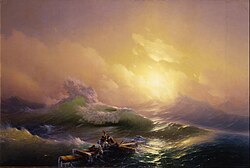
Ninth Wave (1850), by Ivan Aivazovsky, State Russian Museum, Saint Petersburg
Fluorescent light, which is greenish, electric light (generally tungsten or wolfram), which is usually yellow or orange and either direct or diffused, fire and candles, which create red or orange light, and photography flash, which is white, are the main types of artificial light. Mixed illumination, which combines artificial and natural sources, is present in many settings. Light and shadow are in balance in visible reality, with shadows appearing when an opaque object blocks light. The illumination and any things that might cast more shadows affect the gradation between light and shadow. One element may predominate in some circumstances, such as the darkness of night or the brightness of snow or fog. Light-dominated lighting is referred to as high key, whilst dark-dominated lighting is referred to as low key. Mixed illumination, which combines artificial and natural sources, is present in many settings. Light and shadow are in balance in visible reality, with shadows appearing when an opaque object blocks light. The illumination and any things that might cast more shadows affect the gradation between light and shadow. One element may predominate in some circumstances, such as the darkness of night or the brightness of snow or fog.

Madeleine Bay (1841), by François-Auguste Biard, Musée du Louvre, Paris
There are two types of shadows: cast shadows, which are shadows projected onto nearby surfaces, and self shadows, which are shadowed regions on the item itself. Cast shadows establish spatial relationships, whereas self shadows display texture and volume. The penumbra, which is the darkest region, and the umbra, which is the brightest, comprise the shadow structure. The size and location of the light source determine how they appear: large or close sources produce more diffuse edges with stronger umbra, whereas tiny or distant sources produce sharper shadows with dominant penumbra. A secondary or "fill" light can also alter shadows. Their hue changes with contrast, transparency, and translucency and is often between blue and black. Divergent beams with softer boundaries are produced by artificial light, but parallel beams and shadows produced by natural light react closely to obstructions and terrain. Cast shadows establish spatial relationships, whereas self shadows display texture and volume. The penumbra, which is the darkest region, and the umbra, which is the brightest, comprise the shadow structure. The size and location of the light source determine how they appear: large or close sources produce more diffuse edges with stronger umbra, whereas tiny or distant sources produce sharper shadows with dominant penumbra. A secondary or "fill" light can also alter shadows. Their hue changes with contrast, transparency, and translucency and is often between blue and black. Divergent beams with softer boundaries are produced by artificial light, but parallel beams and shadows produced by natural light react closely to obstructions and terrain.
Pictorial representation of light
The point or center of luminous diffusion inside a painting, as well as the lighted areas in respect to the shadows, are referred to as light in artistic terms. Additionally, it indicates if studio light (artificial), zenithal (vertical), high (oblique), or straight (horizontal) illumination is being used. Moonlight and artificial light are examples of non-solar illumination that is referred to as accidental light. Light can enter the composition in a number of ways: zenithal light, which falls from above, somewhat distorts forms; upward or contrapicado light exaggerates distortion; lateral light highlights texture; frontal light reduces shadows and volume; and backlight obscures the figure's silhouette. Light can be dual (figures emerging from a dark background), insertive (interplay of light and shadow), or homogenous (evenly spread) depending on how it is distributed. Focal light, which can be tangible (from a visible light-emitting instrument) or intangible (from an invisible source), diffuse light, which softens contours, actual light, which aims to accurately depict sunlight, and unreal or symbolic light, which is common in religious iconography, are examples of extrinsic light. Light can be compositional (ordering the scene) or conceptual (adding meaning), as in Caravaggio's selective illumination, depending on the purpose. There are two types of light: ambient, which has no defined shadows, and projected, which creates shadows and helps with modeling. The painting's brightest spot is known as the light focus, whereas the object providing light is known as the light source.Chiaroscuro is the interaction of light and shadow; tenebrism is the dominance of darkness. Since light is depicted in paintings rather than being literally present, the artist has complete control over where it comes from.

Caspar David Friedrich in his studio (1819), by Georg Friedrich Kersting, Alte Nationalgalerie, Berlin
Light can enter the composition in a number of ways: zenithal light, which falls from above, somewhat distorts forms; upward or contrapicado light exaggerates distortion; lateral light highlights texture; frontal light reduces shadows and volume; and backlight obscures the figure's silhouette. Light can be dual (figures emerging from a dark background), insertive (interplay of light and shadow), or homogenous (evenly spread) depending on how it is distributed. Focal light, which can be tangible (from a visible light-emitting instrument) or intangible (from an invisible source), diffuse light, which softens contours, actual light, which aims to accurately depict sunlight, and unreal or symbolic light, which is common in religious iconography, are examples of extrinsic light. Light can be compositional (ordering the scene) or conceptual (adding meaning), as in Caravaggio's selective illumination, depending on the purpose. There are two types of light: ambient, which has no defined shadows, and projected, which creates shadows and helps with modeling.
Determining the nature (natural or artificial), origin, intensity, and color properties of light is necessary for its representation. While artificial light varies by source (candles, torches, lamps, neon, etc.), natural light varies by season, time of day, and weather. Light can be diffuse or concentrated, and its chromatic value influences the atmosphere, projected shadows, and object tonality. Under proper lighting, colors appear fully saturated; in shadow, they deepen and aid in the definition of shape. Light and pictorial space are inextricably linked, as is perspective. Light replicates atmospheric influences in aerial perspective and represents volume through gradations of value in linear perspective. The light source can function directly or indirectly, and it can appear inside or outside the scene. The disparity between spatial definition and light and shadow. Light can be diffuse or concentrated, and its chromatic value influences the atmosphere, projected shadows, and object tonality. Under proper lighting, colors appear fully saturated; in shadow, they deepen and aid in the definition of shape. Light and pictorial space are inextricably linked, as is perspective. Light replicates atmospheric influences in aerial perspective and represents volume through gradations of value in linear perspective.

Cotopaxi (1862), de Frederic Edwin Church, Detroit Institute of Arts.
Light can be dual (figures emerging from a dark background), insertive (interplay of light and shadow), or homogenous (evenly spread) depending on how it is distributed. Focal light, which can be tangible (from a visible light-emitting instrument) or intangible (from an invisible source), diffuse light, which softens contours, actual light, which aims to accurately depict sunlight, and unreal or symbolic light, which is common in religious iconography, are examples of extrinsic light. Light can be compositional (ordering the scene) or conceptual (adding meaning), as in Caravaggio's selective illumination, depending on the purpose. There are two types of light: ambient, which has no defined shadows, and projected, which creates shadows and helps with modeling.
Join our classes to enhance & improve your memory skills and let your child unlock the power to retain information from every moment of his/her life!
