
Mandala
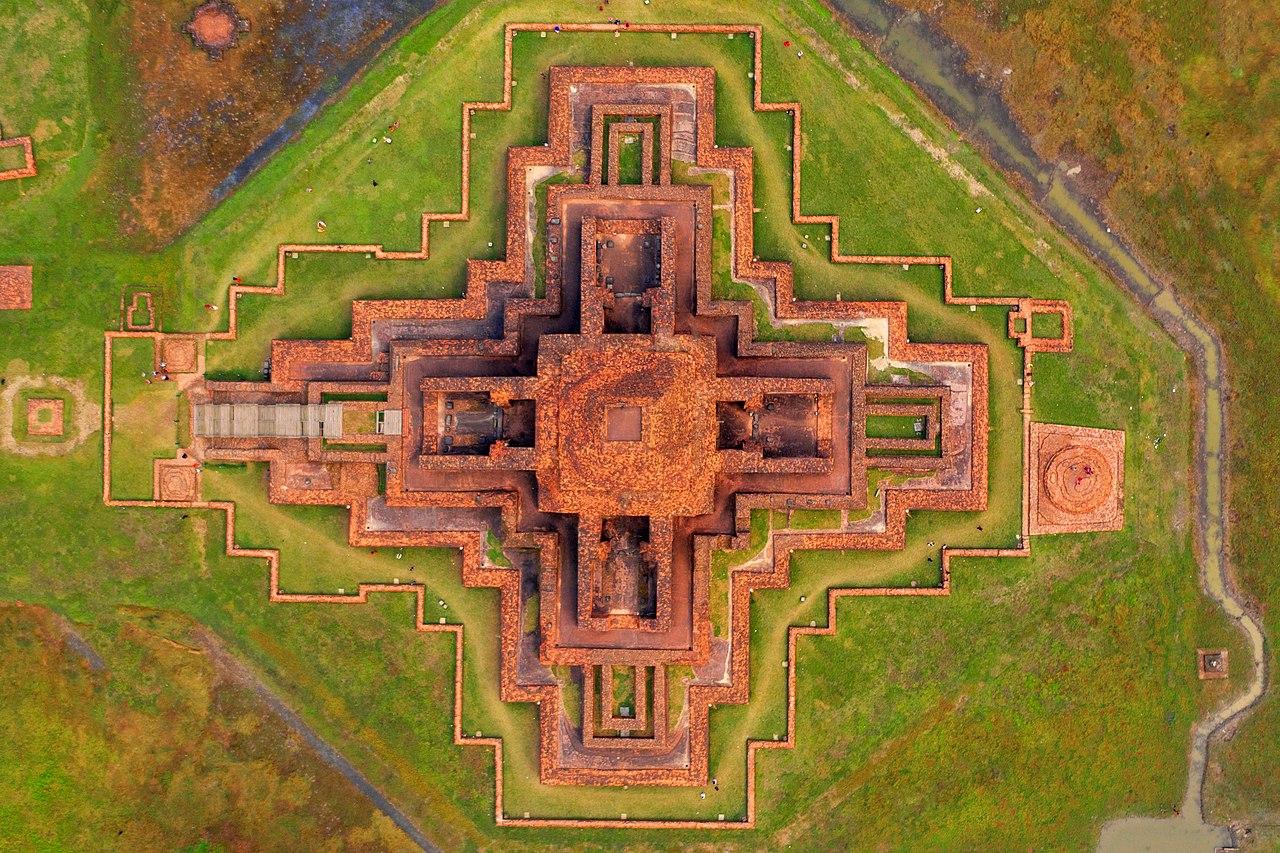
The term "mandala" refers to a geometric arrangement of symbols , romanized: maṇḍala, lit. "circle. Mandalas can be used in a variety of spiritual traditions to help practitioners and adepts focus their attention, create a sacred environment, provide spiritual direction, and facilitate meditation and trance induction. In the Eastern faiths of Buddhism, Jainism, Hinduism, and Shinto, it serves as a map that depicts gods or, in the case of Shinto, actual shrines, kami, or paradises. A basic mandala, also known as a yantra in Hinduism, is shaped as a square with four gates that contain a circle with a center point. Mandalas frequently feature radial balance, and each gate has the overall form of a T. Mandalas can be used in a variety of spiritual traditions to help practitioners and adepts focus their attention, create a sacred environment, provide spiritual direction, and facilitate meditation and trance induction. In the Eastern faiths of Buddhism, Jainism, Hinduism, and Shinto, it serves as a map that depicts gods or, in the case of Shinto, actual shrines, kami, or paradises. A basic mandala, also known as a yantra in Hinduism, is shaped as a square with four gates that contain a circle with a center point.

Thangka painting of Manjuvajra mandala
A yantra is similar to a mandala, usually smaller and using a more limited colour palette. It may be a two- or three-dimensional geometric composition used in sadhanas, puja or meditative rituals, and may incorporate a mantra into its design. It is considered to represent the abode of the deity. Each yantra is unique and calls the deity into the presence of the practitioner through the elaborate symbolic geometric designs. According to one scholar, "Yantras function as revelatory symbols of cosmic truths and as instructional charts of the spiritual aspect of human experience". Like a mandala, a yantra is often smaller and employs a more constrained color scheme. It may have a mantra incorporated into its design and be a two- or three-dimensional geometric composition utilized in sadhanas, pujas, or meditation ceremonies. It is believed to symbolize the deity's residence. Each yantra is distinct and uses intricate symbolic geometric designs to invite the deity into the practitioner's presence. One researcher said, "Yantras function as revelatory symbols of cosmic truths and as instructional charts of the spiritual aspect of human experience".
Yantras are frequently positioned as the focal foci of Hindu tantric practice. Yantras are living, experienced, and nondual realities rather than representations. According to Khanna, a yantra is a reality experienced despite its cosmic connotations. Every symbol in a yantra is ambivalently resonant in inner–outer synthesis and is connected to the subtle body and facets of human consciousness because of the relationship that exists in the Tantras between the outward world (the macrocosm) and man's inner world (the microcosm). Mandalas like the Navagraha mandala are still used in Vedic rites, and the word "mandala" appears in the Rigveda as the name of the divisions of the book.
Buddhism
Mandalas have also evolved into sandpainting in Vajrayana Buddhism. Additionally, they play a major role in Anuttarayoga Tantra meditation techniques.It is possible to demonstrate how the mandala embodies the fundamental ideas of Vajrayana. The characteristics of the Pure Land and the Enlightened mentality are symbolized by the mandala. The Vajrabhairava mandala, a silk tapestry woven with gilded paper that depicts opulent details like crowns and jewelry and gives the item a three-dimensional appearance, is an example of this kind of mandala.A mandala can also illustrate the entire cosmos, which is typically shown with the continents encircling Mount Meru as the axis mundi. As an illustration, consider the Cosmological Mandala with Mount Meru, a Yuan dynasty silk tapestry that was brought to China from Tibet and Nepal and functions as a diagram of Tibetan cosmology. The outer circle of fire in the mandala typically represents knowledge. The Buddhist advice to constantly be aware of death and the impermanence that permeates samsara is symbolized by the ring of eight charnel grounds : "such locations were utilized in order to confront and to realize the transient nature of life."
Described elsewhere: "within a flaming rainbow nimbus and encircled by a black ring of dorjes, the major outer ring depicts the eight great charnel grounds, to emphasize the dangerous nature of human life". The walls of the mandala palace itself, a location inhabited by Buddhas and deities, are located inside these rings. The "Five Buddhas" mandala is a popular kind of mandala that features archetypal Buddha figures that represent different facets of enlightenment. Depending on the Buddhist school and even the mandala's intended use, these Buddhas are portrayed. The Five Wisdom Buddhas (also known as the Five Jinas), the Buddhas Vairocana, Aksobhya, Ratnasambhava, Amitabha, and Amoghasiddhi, are frequently shown in mandalas of this kind. Tantric Buddhists frequently utilize mandalas as a tool for meditation. The mandala is "a support for the meditating person" and should be repeatedly contemplated until it is fully internalized in every detail. At that point, it can be summoned and contemplated whenever desired as a clear and vivid visualized image. Every mandala comes with what Tucci refers to as "its associated liturgy ... contained in texts known as tantras" , which gives practitioners instructions on how to draw, construct, and visualize the mandala as well as the mantras to be said during its ritual use.

Tantric mandala of Vajrayogini
Visualizing "pure lands" teaches one to see experience as pure and the home of enlightenment. According to this perspective, we require protection from both internal and external sources of uncertainty. "The four outer circles: the purifying fire of wisdom, the vajra circle, the circle with the eight tombs, the lotus circle" are frequently used in tantric mandalas to represent this idea of seclusion and defense against the external samsaric world. Around the outer mandala circle, the ring of vajras creates a connected fence-like pattern. The mandala, a sacred enclosure made of concentric squares and circles drawn on the ground that symbolizes the adamant plane of being that the aspirant to Buddha hood wishes to establish himself on, is the most pregnant manifestation of the indistinguishable unity between external ritual and internal sadhana. The mandala is essential to the tantric ritual's development; in the absence of a physical mandala, the skilled practitioner creates one in his mind while meditating.
In Tibetan Buddhism, a symbolic offering of the entire universe is called a "mandala offering." Every minute feature of these mandalas has particular symbolic meanings, frequently on multiple levels, and is entrenched in the tradition.This mandala symbolizes the universe, while the one above depicts a Buddha's pristine surroundings. This kind of mandala is utilized for mandala-offerings, in which the universe is symbolically offered to a teacher or to the Buddhas. Before a student even starts tantric practices, 100,000 of these mandala offerings (to produce merit) can be part of the preparatory exercises in Vajrayana practice.
Nichiren Buddhism
In Nichiren Buddhism, the mandala is called a moji-mandala , which is a wooden tablet or paper hanging scroll with an inscription in Chinese and medieval-Sanskrit script that symbolizes aspects of the Buddha's enlightenment, protecting Buddhist deities, and specific Buddhist ideas. It was first inscribed in the late 13th century by Nichiren, the founder of this branch of Japanese Buddhism, and is known as the Gohonzon. As the embodiment of the highest Dharma and Nichiren's inner enlightenment, the Gohonzon is the principal object of adoration in some Nichiren schools and the only one in others.

Nichiren bowing before MOJI-MANDALA which he wrote.
Pure Land Buddhism
Based on descriptions in the Larger Sutra and the Contemplation Sutra, mandalas have occasionally been utilized in Pure Land Buddhism to visually depict Pure Lands. Dating back to approximately 763 CE, the Taima mandala is the most well-known mandala in Japan. Although the Contemplation Sutra served as the inspiration for the Taima mandala, several comparable mandalas have since been created. It is not utilized for esoteric rituals or as an object of meditation, in contrast to mandalas employed in Vajrayana Buddhism. Rather, it serves as a teaching tool and offers a graphic depiction of the Pure Land writings.

Pure Land Taima Mandala, Kamakura period, 14th century, Japan (Kyushu National Museum)
Shinran and his descendant Rennyo, who also practiced Jodo Shinshu Buddhism, looked for a means to make objects of devotion that the lower levels of Japanese society could easily get. Shinran used a hanging scroll and vertically written nembutsu phrases to create a mandala. Some Jodo Shinshu Buddhists continue to employ this type of mandala in their butsudan, or house altars. Shinran and his descendant Rennyo, who also practiced Jodo Shinshu Buddhism, looked for a means to make objects of devotion that the lower levels of Japanese society could easily get. Shinran used a hanging scroll and vertically written nembutsu phrases to create a mandala. Some Jodo Shinshu Buddhists continue to employ this type of mandala in their butsudan, or house altars.
Sand mandalas
Sand mandalas are vibrant mandalas constructed of sand that are demolished in a ritualistic manner. They are currently practiced in Tibetan Buddhism, but they originated in India between the eighth and twelfth centuries. Every mandala is devoted to a certain god. In Buddhism, deities stand for mental states that can be attained on the way to enlightenment; the mandala itself symbolizes the deity's palace, which in turn symbolizes the deity's mind. Sand mandalas are made by monks who have received three to five years of training at a monastery. Each mandala is a visual depiction of a tantra. The purpose of these sand mandalas is to represent impermanence, the Buddhist conviction that death is not the end and that a person's essence will always return to the elements. Every mandala is devoted to a certain god. In Buddhism, deities stand for mental states that can be attained on the way to enlightenment; the mandala itself symbolizes the deity's palace, which in turn symbolizes the deity's mind. Sand mandalas are made by monks who have received three to five years of training at a monastery. Each mandala is a visual depiction of a tantra. The purpose of these sand mandalas is to represent impermanence, the Buddhist conviction that death is not the end and that a person's essence will always return to the elements.

Sand Mandala in the making
It also has to do with the idea that one should never get connected to anything. In order to make these mandalas, the monks first make a sketch [29]. Then, they fill copper funnels known as Cornetts with colorful sand, which is typically produced from powdered stones and gems, and gently tap the sand out of them to create the sand mandala. Every hue is a representation of a god's qualities. Every grain of sand symbolizes a blessing as the monks pray and concentrate while creating the mandalas. Monks will travel, frequently to museums, to exhibit this art form to the public. It also has to do with the idea that one should never get connected to anything. In order to make these mandalas, the monks first make a sketch [29]. Then, they fill copper funnels known as Cornetts with colorful sand, which is typically produced from powdered stones and gems, and gently tap the sand out of them to create the sand mandala. Every hue is a representation of a god's qualities. Every grain of sand symbolizes a blessing as the monks pray and concentrate while creating the mandalas. Monks will travel, frequently to museums, to exhibit this art form to the public.
Join our classes to enhance & improve your memory skills and let your child unlock the power to retain information from every moment of his/her life!
