
Pattachitra
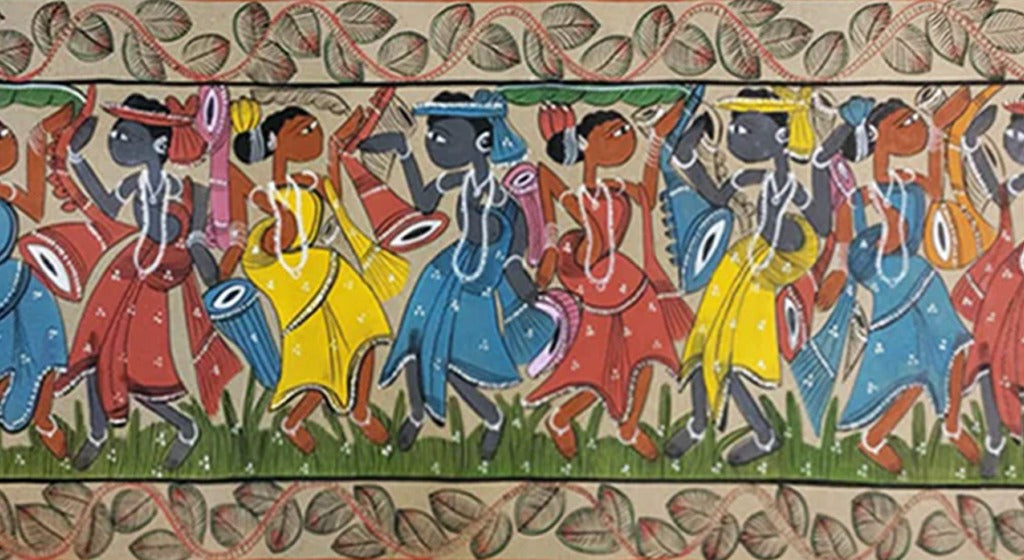
Patachitra, also known as Pattachitra, is a broad word for traditional scroll painting on cloth that is practiced in parts of Bangladesh and the eastern Indian states of Odisha and West Bengal. The Patachitra art form is renowned for its elaborate detailing as well as the folktales and mythological stories it incorporates. One of Odisha's ancient artworks, Pattachitra was first made for ceremonial purposes and as mementos for pilgrims visiting Puri and other Odisha temples. Originally used as a visual aid during song performances, patachitras are a part of an old Bengali tale art.
Ancient paintings known as Charanachitras, Mankhas, and Yamapatas were created on cloth scrolls and dealt with narrative-didactic storytelling themes that are mentioned in Buddhist, Jain, and Hindu writings. Historian N.R. Ray claims that the Pattachitra art form originated from these textile-scroll paintings.
Bengal Patachitra
The painting of Bangladesh and West Bengal is known as the Bengal Patachitra. It is a part of West Bengal's mythological and traditional legacy. Durga Pat, Chalchitra, Tribal Patachitra, Medinipur Patachitra, and Kalighat Patachitra are some of the various divisions of Bengal Patachitra. Bengal Patachitra primarily deals with mythological, religious, folklore, and societal themes. The final Bengali Patachitra tradition, the Kalighat Patachitra, was created by Jamini Roy. Patua is the name of the Bengali Patachitra artist.

Patachitra of Naya village
Origin
Patachitra is renowned for its superb color play. It is a traditional folk art form found in Bengal's rural areas. Regarding the chronology of ancient Patas, there are differing views. However, historical themes associated with the accompanied songs, such as Patua Sangeet, have been proposed. It is still hidden among the tiny settlements of Midnapore, Bankura, Purulia, Howrah, Hooghly, and 24 Parganas and dates back to the Pre-Pala era. The temples in West Bengal's Bankura District have several mural-style Jadu-Patuas paintings.

Jadupatua painting
There are many different kinds of pots, both secular and religious. Religious pots tell tales of Hindu gods and goddesses such as Radha Krishna, Chaitanya, Kali, Shiba, and the most well-known Bengali folklore of Manasha and Chandi, Behula, and Lakshinder. They also include stories from Hindu epics including mythology, Ramayana, and Mahabharata. Important news stories, scandals, accidents, and other events are depicted in secular pots. Examples include bus accidents in Narayangarh, rural elections, the rationing system, family planning, the drawbacks of the dowry system, etc. Each Patachitra has a song associated with it that the performers sing when they unfold the Patachitra. West Bengal folk songs from Jhargram, Bardhaman, and Murshidabad.
Aspects of painting
Bengali Patachitra paintings have distinct motives and elements that reveal Bengali culture. One of the distinctive features of the Bengal Patachitra is the use of the mythological epic and the natural color.
Chalchitra
A component of Bengal Patachitra, Chalchitra refers to the background of the Durga Pratima or idol, the Debi Chal or Durga chala. Patua, which denotes the writing of Patachitra, was referred to as Pata Lekha by the Chalchitra artists. Chalchitra was a component of Pratima in Nabadwip Shakta Rash idols that date back 300–400 years. Chalchitra was once used less frequently, but it is currently very popular.
Durga sara
One variation of the patachitra is the durga sara. An image of the Hindu goddess Durga is painted on the back of a clay tray or dish known in Bengali as "sara," which serves as the canvas instead of a fabric. In areas of West Bengal such as Nadiya and 24 Parganas, impoverished Bengali Hindu families worship it instead of idols.
Sara Lakshmi in West Bengal
The Lakshmi sara and the Durga sara share a similar fashion sense. During the Kojagori Lakshmi Puja celebrations, poorer Bengali Hindu families used this representation of the Hindu goddess Lakshmi instead of idols. Originally limited to the Faridpur and Dhaka regions of East Bengal (now Bangladesh), the art form was brought to West Bengal by Bengali Hindu artists who were escaping religious persecution after the Partition of Bengal, the riots in East Pakistan in 1950, the riots in East Pakistan in 1964, and the genocide in Bangladesh in 1971. Demand from East Bengali refugees drove its sales.


Durga sara, an aspect of Bengal Patachitra
Gazir Pat
A variation on the patachitra theme is the gazir pat. With a focus on Bengali Muslims, it tells the story of Pir Boro Khan Gazi, an Islamic preacher whose grave is located in Ghutiari Sharif. He was known for fighting the Bengali Hindu folk divinity Dakshin Ray as part of his missionary work. He has been elevated to the status of a folk deity by both Dalits and Arzals residing in the Sunderbans, who look to him for protection from Bengal tiger attacks. Bangladesh is home to a large number of artists.
Techniques
The Patachitra of West Bengal's many districts are distinguished by a variety of color and design quirks. The patachitra of Manbhum, now called Purulia, may be clearly identified by their densely packed composition and fondness for a specific shade of burnt sienna that is broken up by white and yellow areas. The Ramayana and Kamale-Kamini scrolls are crowned by the striking and gigantic seated figures of Dasaratha and Chand Sadagar of Medinipur. The Hooghly scrolls preferred a dark brown background, whereas the Birbhum, Bankura, and Burdwan scrolls typically had an Indian red background. The abstract linear treatment of the Hooghly and Manbhum "pats" makes them unusual and unquestionably modernistic.
Colors
One of the distinctive features of the Bengal Patachitra is its use of natural color. The Patachitra of West Bengal generally uses the colors blue, yellow, green, red, brown, black, and white. White is achieved with chalk dust, yellow with pauri, blue with cultivated indigo, black with bhushakali, and red with mete sindur.

Large earthen pot with the outer surface and the lid painted with Pattachitra, Odisha Museum, India.
Artists
Bengal Patua artists are known by their professional surname, "Chitrakar." The village of Naya in the West Bengal district of Medinipur is where they are mostly found. Khandu and Radha Chitrakar, as well as their offspring Bapi, Samir, Prabir, Laltu, Tagar, Mamoni, and Laila Chitrakar, are notable artists. Monimala is renowned for developing her unique iconographic style and for using vivid, primordial colors.
Odisha Pattachitra
An ancient Indian painting from Odisha is called Pattachitra. Hinduism is the foundation of these paintings, which were especially influenced by Vaishnava and Jagannath traditions. Chitrakaras, an Odiya painter, created the paintings using an age-old, traditional method using only natural colors. One of the most ancient and well-liked art forms in Odisha is painting in the Pattachitra style. The Sanskrit terms patta, which means canvas, and chitra, which means image, are the origin of the name Pattachitra. Thus, Pattachitra is a canvas painting that is characterized by rich, colorful application, imaginative motifs, designs, and the representation of straightforward topics, most of which are mythological. The customs surrounding Pattachitra paintings date back over a thousand years.
From the perspective of media, Odisha's paintings can be classified into three groups: paintings on fabric, or "Patta Chitra"; paintings on walls, or "Bhitti Chitra"; and engravings on palm leaves, or "Tala Patra Chitra" or "Pothi, Chitra." Since the artists were then commissioned to create in all of these mediums, it is thought that the style of all of these remained largely unchanged at a certain moment. The painting, known as the Pattachitra, is reminiscent of ancient murals from the fifth century BC seen throughout Odisha, particularly in the sacred centers of Puri, Konark, and Bhubaneswar. Puri and the surrounding areas, particularly the village of Raghurajpur, have the best craftsmanship.
In places like Puri, Raghurajpur, Paralakhemundi, Chikiti, and Sonepur, this ancient Odia painting tradition is still practiced. The Patta style is thought to have originated with Lord Jagannath in his current form. The Puri deities' color palettes resemble those of the Patta style quite a bit. The founding of the current Shri Jagannath shrine in Puri is most likely the first known example of Patta paintings. It could be because sculptures endure longer than paintings. The date is likely according to the paintings seen inside the Lord Jagannath shrines in Puri. The earliest Sitabanji marble paintings at Keonjhar are not entirely in line with the current Patta painting style.The three deities' wooden figures are likewise covered with fabric, smeared with adhesive and chalk, and painted in just four colors: red, yellow, white, and black. The Odias have a long-standing artistic and painting heritage that is as old as the deities themselves. These deities are highly revered by the people and serve as inspiration for their religion, way of life, and activities. The Patta paintings can be dated back to a previous era if the Savara origin of Jagannath is acknowledged. Originally, these paintings served as a replacement for worship on days when the idols were kept private following their ceremonial bath.

Wooden statuettes painted in the Pattachitra style, Kala Bhoomi Odisha Crafts Museum, Bhubaneswar.
Theme and style
The Jagannath and the Vaishnava faith are central to the Odia painting theme. Lord Jagannath, an incarnation of Lord Krishna, has been a primary source of inspiration for Pattachitra culture since its inception. The majority of Pattachitra's topics are mythical, religious tales, and folklore. Lord Jagannath and Radha-Krishna, various "Vesas" of Shri Jagannath, Balabhadra, and Subhadra, temple activities, and the ten avatars of Vishnu based on the "Gita Govinda" of Jayadev, Kama Kujara, Navagunjara, Ramayana, and Mahabharata are the main themes. Additionally, separate artworks of gods and goddesses are being created.
The Pattachitra style is a blend of classical and folk elements, with a greater emphasis on traditional forms. There are Mughal influences in the fashion. Every stance has been limited to a small number of distinct positions. These are not without tedious repeats, although occasionally this is required to highlight the style's narrative quality. The lines are clear, bold, sharp, and angular. Landscapes, viewpoints, and far-off vistas are typically absent. Every episode is perceived in stark contrast to one another. The background on which the characters are depicted is mostly painted crimson and is adorned with floral and foliage motifs. There are ornamental borders on each painting.
Join our classes to enhance & improve your memory skills and let your child unlock the power to retain information from every moment of his/her life!
