
Phad painting
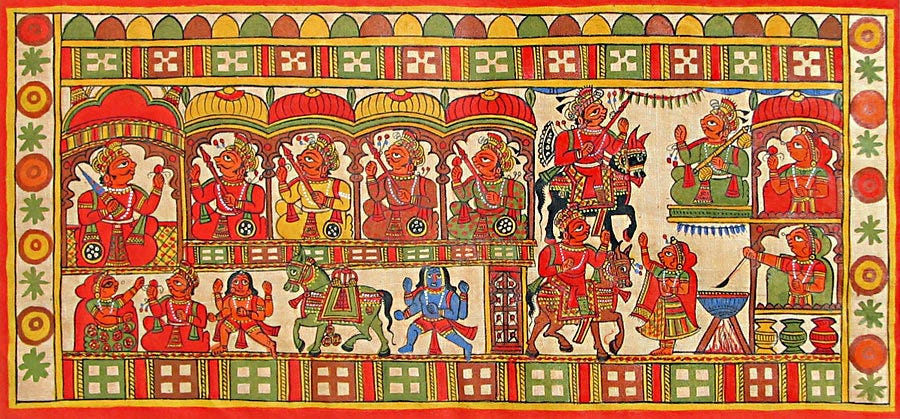
In the universe of the epic of Pabuji, Pabuji Ki Phad is a religious scroll painting of folk deities that is utilized for a musical performance of the sole extant ancient traditional folk art form, Phad painting.The bards and priests of Pabusar are known as bhopas, and they are the customary narrators of this art form. The Phad can alternatively be spelled "Par." Rajasthan, an Indian state, is a renowned destination for this kind of art. The literal translation of "Pabuji Ki Phad" is "The Screen of Pabuji or O, Read of Pabuji." Pabuji is referred to as "the Ascetic Deity of Sand Desert" as well. The Phad or Par, a long scroll painting (or sewn) made on cloth with the martial heroics of Pabuji richly displayed for worship; the epic story of Pabuji, the Rathore chief of Rajasthan in the 13th century, who is praised as an incarnation of Hindu God and worshipped by the Bhil tribal people of Rajasthan; and the bard priests, known as the Bhopas, who belong to the cult of Pabuji and are experts at telling the story of Pabuji in their best.
Folk deities like Pabuji are revered. He resided in the distant Rajasthani village of Kulu around the fourteenth century (the sixteenth century is also reported). Dhadal Rathore of Kolu village had four children: two daughters, Sona and Pema, and two boys, Buro the elder and Pabuji the younger. Pabuji, however, was said to have been born to a nymph, and the nymph had predicted that she would return as a mare to be with him after 12 years. When Pabuji was young, he battled the Khici clan to drive them from the territory they had invaded and murdered Jindrav Khinchi, the clan's chief. During this time, he also purchased a black horse from the Charan Clan's Lady Daval, a goddess revered in Kolu. It is thought that this horse was a reincarnation of his mother. He then defeated Mirza Khan, a Muslim raider known as Muslim marauder Mirza Khan Patan, who was engaged in the slaughter of cows, which are revered by Hindus. He also defended the dignity of women.

Folk-deity Pabuji in Pabuji Ki Phad, a Phad painting at National Museum, New Delhi
The marriage of Pabuji's favorite niece, Kelam, to his friend Gogaji, the snake deity of Rajasthan, was a significant event in his life. Pabuji only promised her camels from Lanka, which is not the island of Sri Lanka but rather a kingdom west of the Indus River, while the couple received lavish presents from the wedding guests, including diamonds, pearls, an exquisite dress made from the finest cloth of South India, white cows, horses, elephants, and so on. After that, he traveled to Lanka in quest of a herd of camels. He brought the herd of camels for his niece after battling and vanquishing the local monarch Ravana of Lanka. He passed to Umarkot in Sindh (now in Pakistan) on his way back with the camels. He married Pulvati, the princess, after much convincing after falling in love with her there.
There are currently just two traditional, modest temples in a courtyard in the Kulu hamlet where Pabu was born, where the Pabuji is offered Puja (worship). The goddess Daval's shrine was located in what was referred to as the "great village fortress of Kolu" village. Despite the construction of numerous more temples across the world, the deity has yet to achieve the level of universal adoration. As a result, Kolu and its surroundings are home to only modest shrines and memorial stones. The Bhopas are a roving, semi-nomadic people who are not anchored in one location where they may construct a temple for regular worship, which is another factor contributing to the lack of proper representation of Pabuji in the form of several temples. Pabuji is revered and regarded as the "myth of their origin" by the Rabaris, a semi-nomadic group who graze cattle in the area.
Because Pabuji was regarded as an ascetic in Rajasthani communities, his disciples, the Bhopas, sought his blessing for veterinary care. By driving out the djinn, he is also called upon to heal children who are possessed by spirits. This is accomplished by tying an amulet made in the early morning, near the end of the Phad's recital, by circling a holy thread seven times around the flame and then making seven knots.The Pabuji tradition is "one multilayered and collective narrative construction of different Rajasthani performers, transmitted in oral and written forms," according to historians who have examined the epic tale of Pabuji in relation to the other epic tales of Ramayana and Mahabharata.

A panoramic view of the Pabhuji Ki Phad displayed in a museum in Europe (Wereldmuseum Amsterdam)
The Phad
The Phad canvas is often a 15-by-15-foot (4.6-by-4.6-meter) sheet of cloth with small scenes illustrating Pabuji's life and adventures painted or embroidered on it.
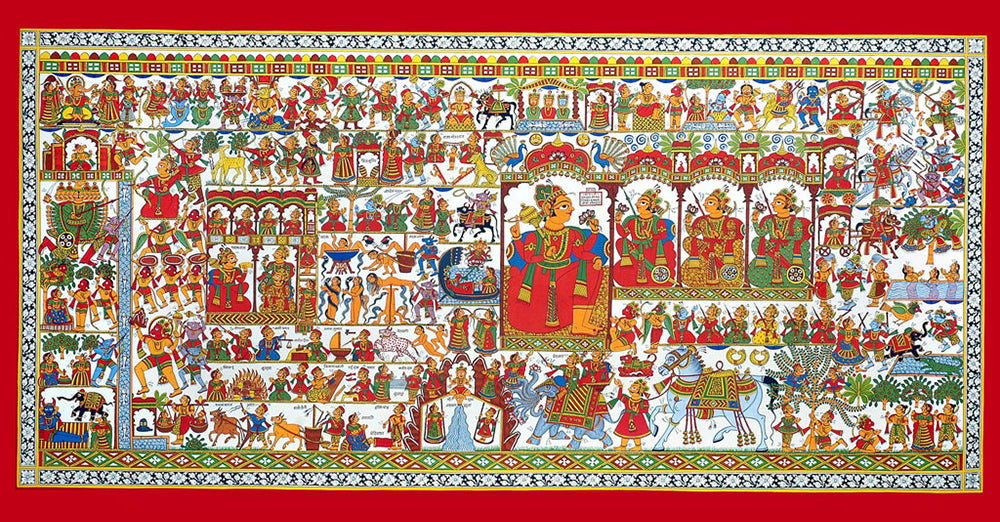
In its painting, the Phad or Par depicts Pabuji's court (as a real Rajput chief from history who gives his life to save others), his palace, his divine persona as an incarnation of Laksmana, the brother of Rama in the Hindu epic Ramayana, the forts where he resided, and the sanctuary of his goddess Deval. Such narratives are always set against the backdrop of Rajasthani desert settlements. The painting's logically structured images depict his nephew's retaliatory actions against his adversary, Jindrav Khici. It is seen as "extremely complex and intricate" from an iconographic perspective, however. Historian William Dalrymple claims that the infobox image depicts a "panorama of medieval Rajasthan: women, horses, peacocks, carts, archers, battles, washer-men and fishermen, kings and queens, huge grey elephants and herds of white cows and buff camels, many-armed demons, fish-tailed wonder-creatures and blue-skinned gods, all arranged around the central outsized figure of Pabuji, his magnificent black mare, Kesar Kalami, and his four great companions and brothers-in-arms.
The Pabuji Ki Phad is painted with the following sequence of figures (see infobox): the major deity, Pabuji, is in the center, his court with his four key friends is to his right, and his sibling Buro's court is to his left. Lanka is on the left edge, and Umarkot lies in the far left. Pabuji's court is to the right of Lady Deval's (the goddess of Kolu) court. The court of Khici is located at the painting's extreme right. Images of Ganesh, Sarasvati, and Vishnu in various incarnations are painted at the top of the Phad or Par, and scenes of Pabuji's trip from Rajasthan to Umarkot are shown in the intervals between them.

Phad Painting depicting the story of "Pabuji Ki Vivaah"
The Bophas give the Phad with the highest respect from the moment it is painted by the famous artists of this art form. Every day, they present offerings to the Phad. It is passed down to a member of their family to carry on the custom and is regarded as a hereditary possession. A specific religious procedure is performed to decommission the Phad when it becomes frayed, damaged, or threadbare. In Hindi, the term "tandakarna" refers to this process, which means "to cool or remove its divine power." This is accomplished by restricting oneself to Pushkar Lake or the sacred waters of the Ganges.
Bhopas
In Rajasthan, the Bhopa community is thought to be made up of Pabuji priest singers. They may be dated back to the 16th century, however the 14th century is also reported. They are from the settlement of Pabusar, which is named after the epic hero. Additionally, Pabuji is credited with locating the village's sweet water spring. They are members of Rajasthan's Nayak community, which is a Scheduled Caste. Phads, which are regarded as the "epic qua religious service," are essential to the Bhopas' profession. "Portable temple" is how the Phad operates. During times of illness and disaster, the villagers summon the Bhopas, who traditionally carry the Phad, to perform in their communities. During transportation, the Phads are maintained rolled. Shortly after dusk, the Bhopas set up the Phad between two poles beneath a shamiana (an open tent) in an appropriate public location after arriving in a hamlet or town. The show lasts all night long and only ends in the early morning.
Narration
The poet-singers tell the story, which is typically told by the Bhopas against the backdrop of Rajasthani deserts, as a structured version of the epic tale known as the Pabuprakasa, which exalts Pabuji as a celestial person. The rendition is "stylized and formulistic in its narration" to a great extent. The numerous episodes in the narrative fall into two distinct categories: the sayls and the parvaros. Specifically, the story of Pabuji is documented in the Khyata of Muhato Nainasi, a work titled Vata Pabujiri. Pabuji and his valiant actions are the subject of the entire narrative. There are four thousand verses in this epic, a courtly religious poetry that invokes Pabuji. It takes five nights and eight hours from twilight to morning to recite it from beginning to end; these days, it is rarely done in its entirety. In addition to the "religious ritual of invoking Pabuji as a living deity," the current narrative style includes numerous breaks for drinking tea, chanting devotional songs (bhajans), and listening to popular movie soundtracks.
The narration, which is melodic and even chanted, is in the informal Rajasthani dialect. The ravanhattho, a spike fiddle or desert zither with eighteen strings but no frets, is a musical instrument that Bhopa, the primary singer and narrator, makes himself. Another member of the musical group is a drum, or dholak. Bhopa's wife, known as the Bhopi, is beside him and sings with him throughout the entire story. When Bhopa points to certain scenes in the Phad that are connected to his tale, she too takes a lantern to illuminate the Phad. The story is narrated by the singer, who uses a stick to indicate each scene. Additionally, he occasionally dances to his songs and jokes and banters with the audience during his performance. These traveling Bhopa groups perform in different regions of Rajasthan. Despite being illiterate, Mohan from Pabusar, one of the epic's well-known narrators, was able to memorize all 4000 lines of the epic.
The epic is narrated in the Rajasthani dialect during the jagarans, or night wakes, in order to invoke the prakas, or the presence of the folk deities. The following is the predetermined order for the narration, which is referred to as the phad vacno or performance in the local tongue.
The Rabari caste, who are traditionally nomadic and camel-herding, are the main audience for the Phad's epic narrations because Pabuji is their primary deity. There are also Rajputs from Pabuji's own martial caste there. It symbolizes the navrasas, or nine types of Indian classical aesthetics, including devotion, love, and battle. It is believed that "a narration of the tale, the gross gets burned around it" because of its captivating theme, which focuses more on bravery. Although they serve the Rajputs of the village, the Rajputs of the royal class also attend the narrative. In order to give Pabuji and the other characters celestial qualities, modern stories have drawn comparisons with the Ramayana incidents. This change is described by one author as "regarding Pabuji and other characters as avatars of Sanskritic deities and personages, though Brahmin influence is still minimal." It appears that Pabuji is worshipped for extremely material goals, such as prosperity, good health, or its recovery, a happy marriage, a successful delivery, and so forth. Moksha, the traditional Brahminic spirituality, and references to the Vedas are still almost completely absent. Every year, between 10,000 and 15,000 people are reported to attend the Pabuji Ki Phad epic narrative festival in Pabusar. The Jaipur Virasat Foundation organizes and promotes this yearly occasion.
Phad painters
Citero is the name of the professional painters who paint the Phads or Pars. The Chhipa caste's "Josi" clan name is associated with well-known professional painters. They operate out of the historic towns of Shahpura and Bhilwara in the Bhilwara district of Rajasthan, and their specialty is textile printing. This art genre is painted by at least seventeen or eighteen different artists. But the most well-known phad painting painters are Shree Lal Joshi and Shanti Lal Joshi, who are renowned for their inventiveness and originality. Additionally, Bhopas claim that Shree Lal Joshi's painting has "the powers to exorcise any spirit...neither the artist nor the Bhopa regarded it as a piece of art once the Phad was complete and the eyes of the hero were painted in." Rather, because Pabuji's followers were semi-nomadic herders, his temple—the Phad—visited the worshippers rather than the other way around, and it immediately became into a mobile temple.

Kalyan Joshi working on a Phad Painting; Image Source: The Hindu
Painting method
It is an art form that is passed down from father to son and is inherited. This picture was commissioned by a Bhopa for religious purposes. The cotton fabric is used to draw the painting. First, a flour and gum mixture is applied to the cloth. After that, it is polished with a stone. Since the Bhopa use it for religious purposes, an auspicious date is selected to begin the painting. Only a virgin female, typically a member of the painter's family or a high caste, is allowed to apply the first brushstroke on a Phad painting. The artist uses light yellow paint to sketch the painting's outline; only earth, vegetable, or indigo colors are used. After that, the colors are combined with gum and water, and the colors are painted one after the other, starting with orange and going up to yellow. The final paint color applied to the border is black. Once more, on a fortunate day, the artist signs the painting near the major deity's picture in the middle of the piece. Although it is not required, the signature of the Bhopa who commissioned the artwork is also included. By opening the pupil in the eyes of the primary deity in the painting's center, the artist is believed to give the work "life" or "awaken the deity" in the last act. After that, it is commissioned by the Bhopa and becomes their Pabuji Ki Phad.
According to John Smith, an expert on the "Epic of Pabuji," the earliest depiction of a Phad or Par dates to 1867. The British Lieutenant Colonel James Tod described a celebration in 1819 that featured a Par painting. Painters of Pars or Phads are also creating Phads as collector's goods in lesser sizes, with various religious and other subjects, while the emphasis on bardic narration of Pabuji Ki Phad is reportedly declining in recent times.
Join our classes to enhance & improve your memory skills and let your child unlock the power to retain information from every moment of his/her life!
