
Pointillism

Pointillism is a painting method where an image is created by applying small, distinct dots of color in patterns. The method was created in 1886 by Georges Seurat and Paul Signac, who broke away from Impressionism. Art critics first adopted the term "Pointillism" in the late 1880s to mock these painters' works, but it is no longer used with the same derogatory meaning. Neo-impressionism is the name of the movement that Seurat started using this method. Although their brushstrokes were bigger and resembled cubes, the Divisionists employed a similar pattern-making technique to create images. Art critics first adopted the term "Pointillism" in the late 1880s to mock these painters' works, but it is no longer used with the same derogatory meaning. Neo-impressionism is the name of the movement that Seurat started using this method. Although their brushstrokes were bigger and resembled cubes, the Divisionists employed a similar pattern-making technique to create images.
The method depends on the viewer's ability to blend the color spots into a wider variety of tones with their eyes and minds. Divisionism, a more sophisticated version of the approach, is connected to it. While pointillism is more concerned with the particular kind of brushwork used to apply the paint, divisionism is more concerned with color theory. The paintings of Seurat, Signac, and Cross are notable examples of pointillism, a technique with few serious practitioners today.Robert Delaunay and Jean Metzinger painted in a Divisionist manner between 1905 and 1907 using enormous squares or "cubes" of color; the size and direction of each gave the painting a feeling of rhythm, but the color varied regardless of size and placement. This type of divisionism represented a substantial advancement over Signac and Cross's concerns. While pointillism is more concerned with the particular kind of brushwork used to apply the paint, divisionism is more concerned with color theory. The paintings of Seurat, Signac, and Cross are notable examples of pointillism, a technique with few serious practitioners today. As art historian Daniel Robbins noted, art critic Louis Chassevent identified the distinction in 1906 and coined the term "cube," which would subsequently be adopted by Louis Vauxcelles to baptize Cubism.

Detail from Seurat's Parade de cirque, 1889, showing the contrasting dots of paint which define Pointillism
Georges Seurat's 1887–1888 Neo-Impressionist painting Parade de cirque (English: Circus Sideshow). One of Seurat's least favored pieces, it debuted at the 1888 Salon de la République des Artistes Indépendants in Paris under the title Parade de cirque, cat. no. 614. Parade de cirque, which depicts the Circus Corvi's sideshow (or parade) in Place de la Nation, was his first picture of popular entertainment and his first portrayal of a nighttime scene. Before finishing the finished picture, Seurat spent over six years working on the theme. Parade de cirque is one of Seurat's most significant works, according to art historian Alfred H. Barr Jr. Measuring 99.7 × 149.9 centimeters (39.3 × 59.0 inches), Circus Sideshow is a big oil painting on canvas. Painted in the Divisionist style, the piece uses a play of lines controlled by rules whose laws Seurat had studied, as well as pointillist dots of color, mostly violet-gray, blue-gray, orange, and green. It shows motionless people outside in artificial lights at the Circus Corvi's sideshow in the working-class neighborhood of Place de la Nation in eastern Paris. Under the surreal nighttime lights of a parade, a row of trombone and cornet players are seen in solemn formation. The piece is dominated by a monotony of vertical and horizontal lines that allude to the rhythms of Egyptian paintings and sculpture. However, Egyptian art is not known for its ability to depict distance.
Horizontally divided into fourths and vertically divided into sixths, the final study of Parade was completed before the oil on canvas. The canvas's dimensions, which are 1.5 times broader than its vertical dimension, match to the 4:6 ratio. Seurat also drew an additional vertical axis that does not exactly match the golden section, 1:1.6, as may have been expected, nor does it correspond to the figures' locations or the work's architectural design. Instead, as highlighted by Seurat with references to Charles Henry, they correspond to fundamental mathematical divisions (basic ratios that seem to mimic the golden section). In the middle of a platform above six stairs are doors and a ticket window that serve as the circus tent's entrance. To attract onlookers, musicians and acrobats perform a sideshow on the balustraded platform on either side of the doors, which are painted green in this instance. The man and lady on the bottom right of the image are the ticket sellers, and those who want to buy tickets go up the central steps. In a line parallel to the sideshow stage are ticket holders. The railing for the auxiliary steps is represented by the diagonal line behind the trombone. On the platform to the right of the ringmaster, a woman and her little daughter are purchasing tickets. Nine gas jets illuminate, casting an orange glow over the musicians to the left.
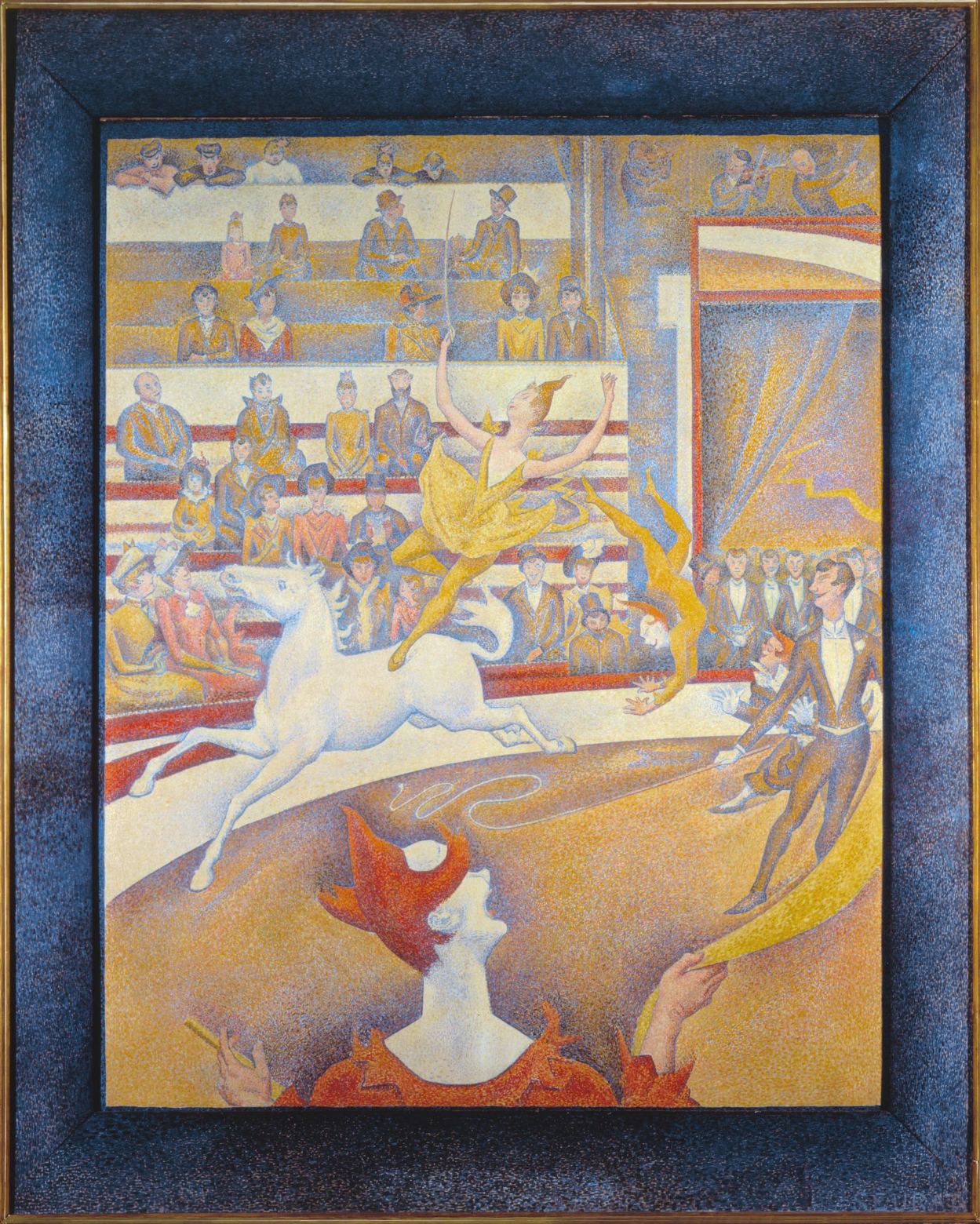
Georges Seurat, 1891, Le Cirque (The Circus), oil on canvas, 185 x 152 cm, Musée d'Orsay, Paris
Gustave Kahn with sympathy said, "In this research, new to him, into the effects of gas [lighting], M. Seurat perhaps may not arrive at the harmonious and seductive impression of Poseuses, but the effort was difficult and the qualities of the painter rest there." Following the piece's 1892 exhibition in Brussels, Kahn offered a similar analysis: "Parade de cirque is conceived in a note of hazy fairground light." The gaslights try to burn through a kind of mist that blurs the sideshow performers. In the center of the image is a clown silhouetted against a boisterous stand. Cirque..., which is, incidentally, the most exquisite painting in the exhibition, is more significant than this one. Parade, according to Jules Christophe, is a "curious essay in nocturnal effects." "Parade de cirque, on the contrary, has little allure, a poverty of silhouette, a pallid appearance with awkward contrasts," remarked Gustave Geffroy after commenting on Seurat's other submissions in the Indépendants.
By 1904, Neo-Impressionism had changed significantly, moving away from imitation and nature and toward the simplification of fundamental geometric shapes and harmonious motions. Because they represented the artist's supremacy over nature and contained ideas, these forms were seen as superior to nature. The younger generation of artists, including Henri-Edmond Cross, Paul Signac, Henri Matisse, Jean Metzinger, Robert Delaunay, and André Derain, started using large brushstrokes that were impossible for the viewer to blend with, as well as pure, bold colors (reds, blues, yellows, greens, and magentas), "making them as free of the trammels of nature" as any painting then being done in Europe, according to Herbert. During the expressionistic stage of proto-Cubism (1908–1910), Paul Cézanne's work had a significant impact, and starting in 1911, the Cubists were drawn to Seurat's work because of its flatter, more linear patterns. Many of the up-and-coming avant-garde, including Jean Metzinger, Robert Delaunay, Gino Severini, and Piet Mondrian, went through a Neo-Impressionist phase before embarking on their Fauve, Cubist, or Futurist projects. Seurat was the founder of Neo-Impressionism and its most inventive and passionate protagonist.
The conventional techniques of combining paints on a palette stand in stark contrast to the art of pointillism. Pointillism is comparable to the four-color CMYK printing method that some color printers and huge presses employ, which involves placing cyan, magenta, yellow, and key (black) dots. Red, green, and blue (RGB) colors are used in a similar manner to depict visual colors on televisions and computer monitors. When red, blue, and green light are combined, the end product is nearly white light (see Prism (optics)). Although pointillist colors frequently appear brighter than usual mixed subtractive colors, painting is fundamentally subtractive. This could be partially due to the avoidance of subtractive pigment mixing and the possibility that some white canvas is visible in between the applied dots.
Vincent Willem van Gogh
One of the most well-known and significant individuals in Western art history is Vincent Willem van Gogh, a Dutch Post-Impressionist painter who lived from March 30, 1853, to July 29, 1890. He produced almost 2,100 pieces of art in just over ten years, including about 860 oil paintings, the majority of which were produced during the final two years of his life. The majority of his works, which include landscapes, still lifes, portraits, and self-portraits, are distinguished by vivid colors and striking brushstrokes that aided in the development of expressionism in modern art. Before he committed suicide at the age of 37, Van Gogh's artwork was only starting to receive critical recognition. Only a few of Van Gogh's paintings were sold during his lifetime, with The Red Vineyard being the most well-known.

Self-Portrait, c. 1887, Art Institute of Chicago
In the final year of his life, Van Gogh's artwork started to garner critical artistic notice. Thanks in great part to the efforts of his widowed sister-in-law Johanna van Gogh-Bonger, his personal story and artwork attracted the public's attention after his death as a symbol of misunderstood genius. Early 20th-century avant-garde creative movements including the Fauves and German Expressionists were influenced by his striking use of color, expressive lines, and thick paint application. In the decades that followed, Van Gogh's paintings were widely praised both critically and commercially, and he came to represent the romantic ideal of the tortured artist. These days, several of Van Gogh's paintings are among the most costly ever sold. In honor of his legacy, the Van Gogh Museum in Amsterdam.

Maximilien Luce, Morning, Interior, 1890, using pointillist technique.
Around 1884, Gausson and Cavallo-Péduzzi exposed Luce to Georges Seurat's Divisionist approach. Luce was inspired by this to start painting in the Pointillist manner. Luce used the "violent effects of light" in his works, which were emotional depictions of modern issues in contrast to Seurat's aloof style. In 1887 he relocated to Montmartre. Paul Signac bought one of Luce's pieces, La Toilette, when he joined the Musée des Artistes Indépendants and took part in their third spring exhibition. The seven Luce pieces on display in the exhibition also impressed Camille Pissarro and critic Félix Fénň. Luce was described by Fénák as a "coarse, honest man, with a rough and muscular talent." From 1887 until his death in 1941, Luce participated in every exhibition at Les Indépendants, with the exception of 1915–1919. This included a 30-year retrospective that took place in 1926. He was chosen vice president of the Musée des Artistes Indépendants in 1909 and president in 1935 after Signac, who had served in that capacity since 1908, passed away . He did, however, resign from the position in 1940 in protest of the rules of the Vichy regime that would have barred Jewish artists from joining the group.
Join our classes to enhance & improve your memory skills and let your child unlock the power to retain information from every moment of his/her life!
