
Sculpture

Within the visual arts, sculpture is the area that works in three dimensions. Sculpture is a three-dimensional piece of art that is physically displayed in height, width, and depth. It belongs to the plastic arts category. In stone, metal, ceramics, wood, and other materials, durable sculpture techniques initially employed carving (the removal of material) and modeling (the addition of material, such as clay). However, since Modernism, there has been nearly total freedom in terms of materials and methods. Carving, welding, modeling, molding, casting, and other removal techniques can all be used to work with a wide range of materials. Stone sculpture, which frequently makes up the majority of the surviving pieces, endures significantly longer than artwork made of perishable materials.
In many civilizations, sculpture has played a major role in religious devotion. Until recently, big sculptures that were too costly for private persons to produce were typically an expression of politics or religion. Many societies in Africa, Central and South America, and the ancient Mediterranean, India, and China are among those whose sculptures have survived in large quantities. Ancient Greece is considered by many to have produced great masterpieces during the classical era, and here is where the Western tradition of sculpture originated. Gothic sculpture during the Middle Ages symbolized the sufferings and fervor of Christianity. Famous sculptures like Michelangelo's statue of David were created throughout the Renaissance by the resurgence of classical models. With the creation of constructed sculpture and the presentation of found objects as completed artworks, modernist sculpture shifted away from conventional methods and the focus on the representation of the human figure.

The Angel of the North by Antony Gormley, 1998
There is a difference between the many kinds of relief, which are at least partially attached to a background surface, and sculpture "in the round"—free-standing sculpture, such as statues, that are not attached to any other surface save potentially at the base. Relief is frequently divided into three categories based on the degree of projection from the wall: high relief, low or bas-relief, and occasionally an intermediate mid-relief. Ancient Egypt was the only place where sunk-relief was used. Relief is a common technique used for both architectural sculpture, which is affixed to buildings, and small-scale sculpture that decorates other objects, such as many pieces of jewelry, metalwork, and pottery. It is also the standard medium for large-figure groups and narrative subjects, which are challenging to achieve in the round.
Subtractive carving techniques, which remove material from an existing block or lump, such stone or wood, and modeling techniques, which shape or build up the work from the material, are another fundamental difference. Casting, stamping, and molding are examples of techniques that use an intermediary matrix containing the design to create the work; several of these methods enable the manufacture of many copies. Steles, which are upright slabs of stone that frequently have inscriptions on them, can also be decorated with relief sculpture. The word "sculpture" is sometimes used primarily to refer to big pieces, which are sometimes referred to as monumental sculpture. This term can refer to either large sculpture or sculpture that is affixed to a building. Many unconventional types of sculpture have been incorporated into modern and contemporary art, such as land art, site-specific art, kinetic sculpture (including elements of physical motion), street art, light sculpture, sound sculpture, and environmental sculpture. One significant kind of public art is sculpture. A sculpture garden is a group of sculptures placed in a natural setting. Another perspective holds that structures are a form of sculpture; in the words of Constantin Brâncuň, "Architecture is inhabited sculpture."
Purposes and subjects
Sculpture is frequently used for religious purposes in one way or another. Though they are frequently not the enormous sculptures of deities that typified ancient Greek art, such as the Statue of Zeus at Olympia, cult representations are prevalent in many civilizations. Even in the biggest temples, the actual cult pictures in the deepest sanctuaries of Egyptian temples—of which none have survived—were clearly quite modest. This is frequently the case in Hinduism, where the lingam is most prevalent in its most basic and primitive form. Buddhism introduced religious figure sculpture to East Asia, where no prior comparable tradition appears to have existed. However, basic shapes like the cong and bi most likely had religious significance.
The usage of very huge sculpture as public art, particularly to impress the observer with the authority of a ruler, dates at least to the Great Sphinx of approximately 4,500 years ago, while small sculptures as personal belongings date back to the earliest ancient art. The appearance, and occasionally disappearance, of large or monumental sculpture in a culture is considered to be of great significance in archaeology and art history. However, tracing the emergence is frequently complicated by the presumed existence of sculpture made of wood and other perishable materials, of which no record survives. One example of a tradition of monumental wood sculpture that would leave no evidence for archaeology is the totem pole. It is thought to be a sign of a relatively sophisticated society in terms of social organization to be able to mobilize the resources necessary to construct massive sculpture by transporting typically very heavy materials and making arrangements for the payment of what are typically thought of as full-time sculptors. Many preconceived notions about early Chinese culture have been challenged by the recent, unexpected discoveries of ancient Chinese Bronze Age figurines at Sanxingdui, some of which are more than twice human size. Previously, only considerably smaller bronzes were known. Despite creating extremely complex figurines and seals, some clearly evolved cultures, like the Indus Valley civilization, don't seem to have produced any monumental sculpture at all. At the time of its collapse, the Mississippian culture appears to have been moving toward its use with miniature stone figures.

Moai from Easter Island, where the concentration of resources on large sculpture may have had serious political effects
Other cultures, like the Easter Island culture and ancient Egypt, appear to have invested a great deal of money in colossal sculpture from very early on. Sculpture collections, including those from earlier eras, date back almost 2,000 years to Greece, China, and Mesoamerica. Long before the modern museum was created, many collections were on semi-public display. The comparatively narrow choice of subjects found in monumental sculpture has increased starting in the 20th century, with abstract subjects and the use or portrayal of any kind of subject now popular. Nowadays, a lot of sculpture is created for sporadic exhibition in galleries and museums, and the capacity to move and store the ever-larger pieces plays a role in their creation. Though oddly ignored by modern and contemporary art, small decorative figurines, usually made of ceramics, are just as common today as they were during the Rococo period, in ancient Greece when Tanagra figurines were a significant business, or in East Asian and Pre-Columbian art. As evidenced by the Nimrud ivories, Begram ivories, and artifacts from Tutankhamun's tomb, little sculpted fittings for furniture and other items date back thousands of years.The Narmer Palette, which depicts a monarch from the 32nd century BCE, and the 27 surviving statues of Gudea, who ruled Lagash between 2144 and 2124 BCE, are examples of how portrait sculpture originated in Egypt and Mesopotamia. The building of a portrait statue in a public setting was considered the ultimate honor in ancient Greece and Rome, and it represented the aspirations of the elite, who may also be shown on a coin.

Medal of John VIII Palaeologus, c. 1435, by Pisanello, the first portrait medal, a medium essentially made for collecting
In other cultures, like Egypt and the Near East, public statues were almost solely reserved for the monarch; other affluent individuals were only shown in their graves. Beginning with the enormous skulls of the Olmec people about 3,000 years ago, portraits in Pre-Columbian societies were usually reserved for rulers. Leading clergy, particularly monastery founders, were honored with statues in East Asian portrait sculpture, which was exclusively religious and did not honor kings or ancestors. During the Middle Ages, the Mediterranean tradition was renewed, originally primarily for tomb effigies and coins. However, it dramatically extended during the Renaissance, when new forms like the personal portrait medal were created.
In China, animals and monsters are nearly the only customary subjects for stone sculpture outside of tombs and temples. Animals, together with the human figure, are the first subjects for sculpture and have always been popular, sometimes realistic but sometimes fantastic creatures. The kingdom of plants is only significant in jewelry and ornamental reliefs, but they make up nearly all of the large sculptures found in Byzantine and Islamic art. They are also highly significant in the majority of Eurasian traditions, where themes like the palmette and vine scroll have been used for more than two millennia. Specialized enlargements of common tools, weapons, or vessels made of valuable but impractical materials are one type of sculpture that may be found in many prehistoric cultures worldwide. These sculptures can be used as offerings or for ceremonial purposes. China, Olmec Mexico, Neolithic Europe, and early Mesopotamia all used jade or other forms of greenstone, and enormous stone pottery forms were made there. The Oxborough Dirk and other big axes and blades were made of bronze in China and Europe.
Materials
Sculpture is made of a variety of materials that have evolved over time. Wood, bone, and antler are less durable but less expensive alternatives to metal, particularly bronze, stone, and ceramics, which are the traditional materials of exceptional durability. Gold, silver, jade, and ivory are examples of precious materials that are frequently employed in little luxury pieces and occasionally in bigger ones, such as chryselephantine statues. Hardwoods (such as oak, box/boxwood, and lime/linden), terracotta and other ceramics, wax (a very common material for models for casting and receiving the impressions of cylinder seals and engraved gems), and cast metals (such as pewter and zinc (spelter)) were among the more widely available and less expensive materials used for sculpture for wider consumption.

Sumerian male worshipper, alabaster with shell eyes, 2750–2600 BCE
However, a wide variety of various materials have been incorporated into sculptures, both in contemporary and ethnographic pieces.Sculptures are frequently painted, yet they frequently lose their paint due to restoration or aging. Tempera, oil painting, gilding, house paint, aerosol, enamel, and sandblasting are just a few of the many painting methods that have been employed to create sculpture. In order to create art, many sculptors look for novel techniques and materials. Bicycle pieces were used in one of Pablo Picasso's most well-known sculptures. Painted steel was a remarkable tool used by modernists like Alexander Calder and others. Acrylics and other plastics have also been employed since the 1960s. Andy Goldsworthy creates his remarkably transient sculptures in natural environments using nearly all natural materials. Certain types of sculpture are intentionally transient, such as gas, sand, and ice sculpture. Stained glass, tools, hardware, machine parts, and consumer packaging have all been employed by contemporary sculptors to create their pieces. Found artifacts are occasionally used by sculptors, and Chinese scholars have valued rocks for many years.
Stone
Stone sculpture is an age-old practice in which natural stone fragments are carefully removed to create shapes. Although not all parts of the world have as much suitable stone for carving as Egypt, Greece, India, and most of Europe, there is evidence that even the earliest communities engaged in some kind of stone work due to the material's permanency. Perhaps the earliest type are petroglyphs, also known as rock engravings, which are images made by incising, pecking, cutting, and abrading a portion of a rock surface that is still in place.Traditionally, "pointing" and other freehand techniques were used to replicate an original statue in stone, which was crucial for ancient Greek statues, almost all of which are known via reproductions. Pointing entailed placing a grid of string squares on a wooden frame around the original, measuring each point's location on the grid and the separation between the grid and the statue, and then using this information to carve into the block used to create the copy.

Modern plaster recreation of the original painted appearance of a Late Archaic Greek marble figure from the Temple of Aphaea, based on analysis of pigment traces,c. 500 BCE. From the Gods in Color exhibition.
Metal
The oldest and most often used metals for cast metal sculptures are bronze and related copper alloys; a cast bronze sculpture is frequently referred to as just a "bronze." The unique and advantageous characteristic of common bronze alloys is that they expand somewhat right before they set, filling the smallest details of a mold. When creating figures in action, their strength and absence of brittleness (ductility) are advantageous, particularly when contrasted to different ceramic or stone materials (see granite or marble sculpture for more examples). Silver is soft enough to be cast and manipulated with hammers and other tools, whereas gold is the most valuable and softest metal and is crucial for jewelry. Casting is a collection of manufacturing techniques in which a liquid substance (such as iron, copper, glass, aluminum, or bronze) is typically poured into a mold that has a hollow chamber of the required shape and then allowed to harden. The process is subsequently completed by ejecting or breaking out the solid casting, but there may be a final "cold work" step for the completed cast. Hot liquid metals or a variety of materials that cold set after component mixing (such as epoxies, concrete, plaster, and clay) can be formed through casting. The most common use of casting is to create intricate shapes that would be challenging or costly to create using other techniques. A Mesopotamian frog made of copper that dates back to 3200 BCE is the oldest known casting.

Ludwig Gies, cast iron plaquette, 8 x 9.8 cm, Refugees, 1915
The technique of welding involves fusing several metal components together to produce a variety of forms and patterns. There are numerous types of welding, including MIG, TIG, stick, oxy-fuel, and stick welding. When it comes to manufacturing steel sculptures, oxy-fuel welding is arguably the most popular technique because it is the simplest to use for both shaping the steel and generating smooth, undetectable joints. The secret to oxy-fuel welding is to heat every piece of metal to be bonded uniformly until they are all red and shiny. The shine that appears on each piece will quickly turn into a "pool" where the welder must liquify the metal. The area where the pools united is now one continuous piece of metal once it has cooled. Forging is also a major component in the construction of oxy-fuel sculptures. The process of forging involves heating metal to a degree where it becomes sufficiently pliable to be formed into various shapes. Heating the end of a steel rod and striking the red, heated tip with a hammer while it is on an anvil to create a point is one extremely popular example. A steel rod's dull end is gradually sharpened by the forger's rotation of the rod in between hammer strikes.
Glass
Although there are many different ways to work with glass for sculpture, the usage of it for huge pieces is relatively new. The Roman Lycurgus Cup is nearly unique, although it can be carved, albeit with significant difficulty. Glass can be molded in a number of ways, including hot casting, which involves ladling molten glass into molds made by pressing shapes into sand, carved graphite, or intricate plaster/silica molds. Glass chunks are heated in a kiln until they become liquid and flow into a waiting mold beneath them. This process is known as kiln casting glass. Additionally, hot glass can be used as a solid mass or as a component of a blown sculpture when blown and/or hot sculpted with hand tools.The Roman Lycurgus Cup is nearly unique, although it can be carved, albeit with significant difficulty. Glass can be molded in a number of ways, including hot casting, which involves ladling molten glass into molds made by pressing shapes into sand, carved graphite, or intricate plaster/silica molds. Glass chunks are heated in a kiln until they become liquid and flow into a waiting mold beneath them.

Dale Chihuly, 2006, (Blown glass)
Pottery
One of the earliest materials used for sculpture is pottery, and many sculptures made of metal were first modeled in clay. Sculptors frequently use transient materials like plaster of Paris, wax, unfired clay, or plasticine to create tiny, preparatory pieces known as maquettes. Small figurines have frequently been as popular as they are in contemporary Western society, and many cultures have developed ceramics that combine a sculptural shape with a vessel function. The majority of ancient societies, including Mesopotamia, China, and ancient Rome, used stamps and molds. Sculptors frequently use transient materials like plaster of Paris, wax, unfired clay, or plasticine to create tiny, preparatory pieces known as maquettes. Small figurines have frequently been as popular as they are in contemporary Western society, and many cultures have developed ceramics that combine a sculptural shape with a vessel function. The majority of ancient societies, including Mesopotamia, China, and ancient Rome, used stamps and molds.

A carved wooden Bodhisattva from China's Song dynasty 960–1279, Shanghai Museum
Wood carving
Although wood carving has been used extensively, it is far less durable than the other primary materials because to its susceptibility to fire, decay, and insect damage. As a result, it plays a significant role as a hidden component in the art history of numerous cultures. Most of the world's outdoor wood sculptures are short-lived, so we don't really know how the totem pole tradition evolved. The vast majority of sculpture from Africa, Oceania, and other regions is made of wood, as are many of the most significant sculptures from China and Japan in particular. Wood can take extremely fine detail and is lightweight, making it ideal for masks and other sculptures meant to be carried. Compared to stone, it is also far simpler to work. As a result, it plays a significant role as a hidden component in the art history of numerous cultures. Most of the world's outdoor wood sculptures are short-lived, so we don't really know how the totem pole tradition evolved. The vast majority of sculpture from Africa, Oceania, and other regions is made of wood, as are many of the most significant sculptures from China and Japan in particular.

Detail of Crucifixion of Jesus Christ, Spanish, wood and polychrome, 1793
Ancient Egypt
Although the enormous sculptures of ancient Egypt are well-known worldwide, there are far more exquisite and delicate little pieces. The unique method of sunk relief, which works best in extremely bright sunshine, was employed by the Egyptians. The primary figures in reliefs follow the same figure convention as in paintings, with the head and legs (when not seated) displayed from the side and the torso from the front. The figure is composed of a standard set of proportions, with 18 "fists" extending from the ground to the forehead's hairline. The Narmer Palette from Dynasty is the earliest example of this. However, the practice is not applied there, as it is elsewhere, for minor figures depicted participating in an activity, like the dead and hostages. According to some customs, sculptures of men are darker than those of women. Except for the artwork of Ahkenaten's Amarna period and a few other periods like Dynasty XII, very conventionalized portrait statues date back to Dynasty II, before 2,780 BCE. Like other Egyptian artistic conventions, the idealized features of rulers did not significantly change until after the Greek conquest.
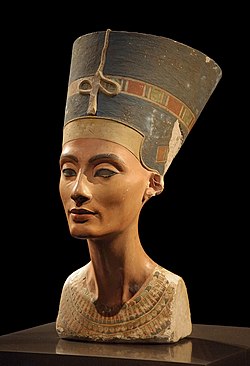
Thutmose, Bust of Nefertiti, 1345 BCE, Egyptian Museum of Berlin
Egyptian pharaohs were traditionally revered as gods, but other gods are rarely depicted in massive statues—unless they are depicting the pharaoh as another deity—though they are often depicted in paintings and reliefs. Rameses II is depicted in the well-known series of four enormous statues outside Abu Simbel's main temple. The statues are standard in design, but they are particularly big in this instance. Small representations of gods or animal personifications of them are frequently seen in everyday materials like ceramics. The majority of larger sculptures that have survived come from Egyptian temples or tombs; the concept of the Ka statue was well-established by at least Dynasty IV (2680–2565 BCE).Since Egypt is one of the few places in the world where the environment permits wood to survive over millennia, we have a good number of unconventional sculptures of wealthy administrators and their wives. These were placed in graves as a resting place for the ka portion of the soul. Particularly realistic are the "reserve heads," which are simply hairless heads. Small models of slaves, animals, structures, and items like boats that the deceased would need to carry on with his life in the afterlife were also found in early graves, along with later Ushabti figures.
Egyptian pharaohs were always revered as gods, but other gods are rarely depicted in massive statues—unless they are depicting the pharaoh as another deity—but they are often depicted in reliefs and paintings. Rameses II is depicted in the well-known series of four enormous statues outside Abu Simbel's main temple. The statues are standard in design, but they are particularly big in this instance. Small representations of gods or animal personifications of them are frequently seen in everyday materials like ceramics. The majority of larger sculptures that have survived come from Egyptian temples or tombs; the concept of the Ka statue was well-established by at least Dynasty IV (2680–2565 BCE). These were placed in graves to serve as a location for the soul's ka portion to rest. Rameses II is depicted in the well-known series of four enormous statues outside Abu Simbel's main temple. The statues are standard in design, but they are particularly big in this instance. Small representations of gods or animal personifications of them are frequently seen in everyday materials like ceramics.
Join our classes to enhance & improve your memory skills and let your child unlock the power to retain information from every moment of his/her life!
