
Self- Portrait

Self-portraits are images created by artists of themselves. Despite the fact that self-portraits have been created since antiquity, it wasn't until the middle of the 15th century that it became common to see painters portraying themselves as either the primary subject or significant figures. Many painters, sculptors, and printmakers experimented with self-portraiture as a result of improved and more affordable mirrors and the introduction of panel portraits. Jan van Eyck's 1433 painting Portrait of a Man in a Turban might be the oldest known panel self-portrait. He was a member of the social group that had started commissioning portraits, which were already more prevalent among affluent Netherlanders than those south of the Alps. Many painters, sculptors, and printmakers experimented with self-portraiture as a result of improved and more affordable mirrors and the introduction of panel portraits. Jan van Eyck's 1433 painting Portrait of a Man in a Turban might be the oldest known panel self-portrait. He was a member of the social group that had started commissioning portraits, which were already more prevalent among affluent Netherlanders than those south of the Alps. He also painted a separate picture of his wife. The genre has a long history, although it didn't really gain popularity until the Renaissance, when affluence and interest in the individual as a subject surged.

Vincent van Gogh, Self-portrait without beard, end September 1889, (F 525), Oil on canvas
The majority of well-known artists have at least left drawings of themselves by the Baroque era. There was a market for printed portraits of artists, many of which were self-portraits. Additionally, they were occasionally presented as presents to loved ones. If nothing else, they avoided having to make arrangements for a model, and for the numerous professional portrait painters, a self-picture stored at the studio served as a showcase for their abilities to prospective new customers. Rembrandt's extraordinary quantity of self-portraits, both in paintings and prints, demonstrated the form's potential and must have fueled the trend even further.
Types
A self-portrait can be a portrait of the artist or a portrait that is part of a larger piece, such as a group portrait. Many painters are said to have included depictions of particular people, including themselves, when painting figures in religious or other types of composition; these paintings were not meant to publicly depict the actual people as themselves, but the artist and patron would have known the facts at the time, creating a talking point and a public test of the artist's skill. Historical or mythical scenes (from the Bible or classical literature) were portrayed in the earliest extant examples of medieval and Renaissance self-portraiture using a variety of real people as models, frequently including the artist, giving the piece multiple functions as portraiture, self-portraiture, and history/myth painting. The artist typically appears as a face in the crowd or group in these pieces, frequently behind the primary players and toward the work's borders or corners. The Four Philosophers by Rubens is an excellent illustration. The work of Jan de Bray in the 17th century marked the culmination of this. In addition to paintings, a variety of artistic media have been employed; drawings and prints have been particularly significant.

Self-portrait by Judith Leyster, a Dutch Golden Age painter, mostly of genre subjects. NGA, 1630.
Jan van Eyck is most likely one of two people seen in a mirror in the well-known Arnolfini Portrait (1434)—a remarkably contemporary idea. Diego Velázquez may have been influenced by the Van Eyck picture, which was displayed in the palace in Madrid where he worked, to portray himself as the painter of Las Meninas (1656). Given that he appears as the painter (before unseen in official royal portraiture) and is positioned among the King's family group, who were the painting's purported primary subjects, this was yet another modern flourish. Albrecht Dürer portrays himself as a 13-year-old boy in a naturalistic way in 1484, possibly one of the oldest childhood self-portraits to have survived. It's possible that Leonardo da Vinci drew a portrait of himself around 1512, when he was sixty years old. Although this is not always the case, the image is frequently simply replicated as Da Vinci's appearance. which was displayed in the palace in Madrid where he worked, to portray himself as the painter of Las Meninas . Given that he appears as the painter (before unseen in official royal portraiture) and is positioned among the King's family group, who were the painting's purported primary subjects, this was yet another modern flourish.
Rembrandt created a variety of self-portraits throughout the 17th century. One of the first self-portraits with family is The Prodigal Son in the Tavern (c. 1637), which most likely features Rembrandt's wife Saskia, one of the first representations of a family member by a well-known artist. From the 17th century onward, family and professional group paintings—including the artist's portrayal—became more prevalent. Video began to play a bigger role in self-portraiture in the latter half of the 20th century. It also included audio, which allowed the subject to address an audience.
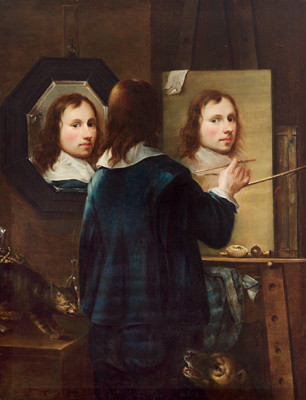
Johannes Gumpp, 1646, shows how most self-portraits were painted.
Women Painters
The majority of notable female painters, including Caterina van Hemessen, the prolific Elisabeth Vigée Le Brun, Frida Kahlo, Alice Neel, Paula Modersohn-Becker, and Jenny Saville, have left behind self-portraits. In all, Vigée-Lebrun created 37 self-portraits for sale, several of which were replicas of prior works. Many artists focused on painting portraits since, up until the 20th century, women were typically unable to train in drawing the nude, which made it challenging for them to paint massive figure compositions. In the past, female painters have played a variety of roles in their self-portraits. The artist at work, either painting or at least holding a brush and palette, is the most typical image. The intricacy of many garments was an artistic decision to demonstrate her expertise at exquisite detail, and the observer frequently questions whether the attire was what they typically painted in. From 1925 until 1954, Mexican painter Frida Kahlo was working. She started painting while confined to bed after suffering severe injuries in a bus accident. The majority of her work is made up of self-portraits that directly address her battle with infertility, health problems, and her troublesome Frida, which she uses to express her suffering. According to academic interpretations, Kahlo used her self-portraits as a means of reclaiming her body from gender norms and health problems. The artist at work, either painting or at least holding a brush and palette, is the most typical image. The intricacy of many garments was an artistic decision to demonstrate her expertise at exquisite detail, and the observer frequently questions whether the attire was what they typically painted in. From 1925 until 1954, Mexican painter Frida Kahlo was working. She started painting while confined to bed after suffering severe injuries in a bus accident.
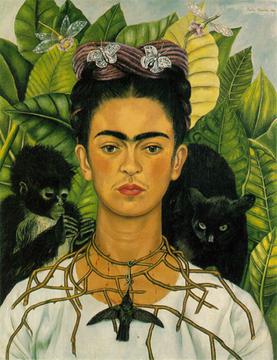
Frida Kahlo, Self-Portrait with Thorn Necklace and Hummingbird, 1940
Renaissance and Baroque
The great Italian Renaissance painters frequently incorporated themselves into bigger works, although they produced very few formal painted self-portraits. The majority of the individual self-portraits they have left are simple portrayals; Dürer's showmanship was hardly observed, though Giorgione's controversially claimed self-portrait as David would have something of the same spirit if it were a self-portrait. Pietro Perugino's portrait from around 1500 (Collegio del Cambio of Perugia) and the youthful Parmigianino's depiction of the view in a convex mirror are both present. Additionally, there is a drawing by Leonardo da Vinci (1512) [18] and self-portraits in larger works by Michelangelo, who painted the female form as an object of love and gave his face to the skin of St.
Two 1560s pictures of Titian as an elderly man are also noteworthy. In his Marriage at Cana, Paolo Veronese plays the violin while dressed in white, joined by Titian on the bass viol (1562). Individual portraits, which frequently resembled those of their fellow bourgeois subjects, continued to be produced by Northern artists. Around 1573, Johan Gregor van der Schardt created a painted terracotta bust of himself. It is believed that Titian, his son Orazio, and a young relative named Marco Vecellio are shown in Titian's Allegory of Prudence (c. 1565–70). In 1567, Titian also created a late self-portrait, which is thought to be his first. The great Italian Renaissance painters frequently incorporated themselves into bigger works, although they produced very few formal painted self-portraits. The majority of the individual self-portraits they have left are simple portrayals; Dürer's showmanship was hardly observed, though Giorgione's controversially claimed self-portrait as David would have something of the same spirit if it were a self-portrait. Pietro Perugino's portrait from around 1500 (Collegio del Cambio of Perugia) and the youthful Parmigianino's depiction of the view in a convex mirror are both present.

Gentile Bellini, black chalk, 1496 or earlier, Berlin
Gentile Bellini, sometimes known as Zentil Belin, was a Venetian painter from the Venice style who lived from approximately 1429 until February 23, 1507. He was from the most prominent painting family in Venice and, at least early in his career, was considered more highly than his younger brother Giovanni Bellini—a scenario that is now reversed. He served as the Doges of Venice's official portrait artist starting in 1474. Apart from his portraits, he created several enormous pieces featuring numerous persons, particularly for the Scuole Grandi of Venice, affluent associations that played a significant role in Venetian patrician social life. Apart from his portraits, he created several enormous pieces featuring numerous persons, particularly for the Scuole Grandi of Venice, affluent associations that played a significant role in Venetian patrician social life.
After Rembrandt
Self-portraits by Diego Velázquez and Bartolomé Estéban Murillo were found in Spain. In Luke the Evangelist, Francisco de Zurbarán depicted himself at the feet of Christ on the cross (c. 1635). Goya painted himself several times in the 19th century. French self-portraits, at least after Nicolas Poussin, typically depict the artist's social standing; but, certain artists, like Jean-Baptiste-Siméon Chardin, depicted their actual working attire in a very realistic manner. All 18th-century self-portraitists had to make this choice, even though many of them portrayed themselves in both formal and casual attire in separate works. Even with the collapse of painted portraits with the advent of photography, it can be said that the majority of notable artists left us at least one self-portrait.

Self-Portrait of Van Gogh with head bandaged, after he (debatedly) cut off part of his ear.
The Artist's studio and Bonjour, Monsieur Courbet are among the biggest self-portraits ever created. Gustave Courbet (see below) was arguably the most inventive self-portraitist of the 19th century. Despite having a large number of figures, both are firmly focused on the heroic figure of the artist. Between 1886 and 1889, Vincent van Gogh painted and sketched himself over 43 times, making him one of the most well-known and prolific self-portraitists. One is impressed by how rarely the painter's attention is locked on the viewer in any of these self-portraits; even when it is, he appears to be looking elsewhere. Some of these paintings show the artist wearing bandages, symbolizing the incident in which he severed. Pablo Picasso frequently utilized self-portraits throughout his lengthy career to show himself in the various incarnations, disguises, and guises of his autobiographical artistic identity. From the "ancient Cavalier" and "lecherous elderly artist and model" periods to the "Minotaur in the Labyrinth" and "young, unknown "Yo Picasso" periods. Picasso frequently captured complex psychological insights regarding the inner state and well-being of the artist in his self-portraits. These insights were profound and personal. Pierre Bonnard was another artist who created intimate and candid self-portraits over the course of his career. Over the course of his wife Marthe's life, Bonnard also created numerous pictures of her. Particularly, Vincent van Gogh, Paul Gauguin, Egon Schiele, and Horst Janssen created powerful—and even unsettling—self-portraits during their careers.
Join our classes to enhance & improve your memory skills and let your child unlock the power to retain information from every moment of his/her life!
