
Warli Art
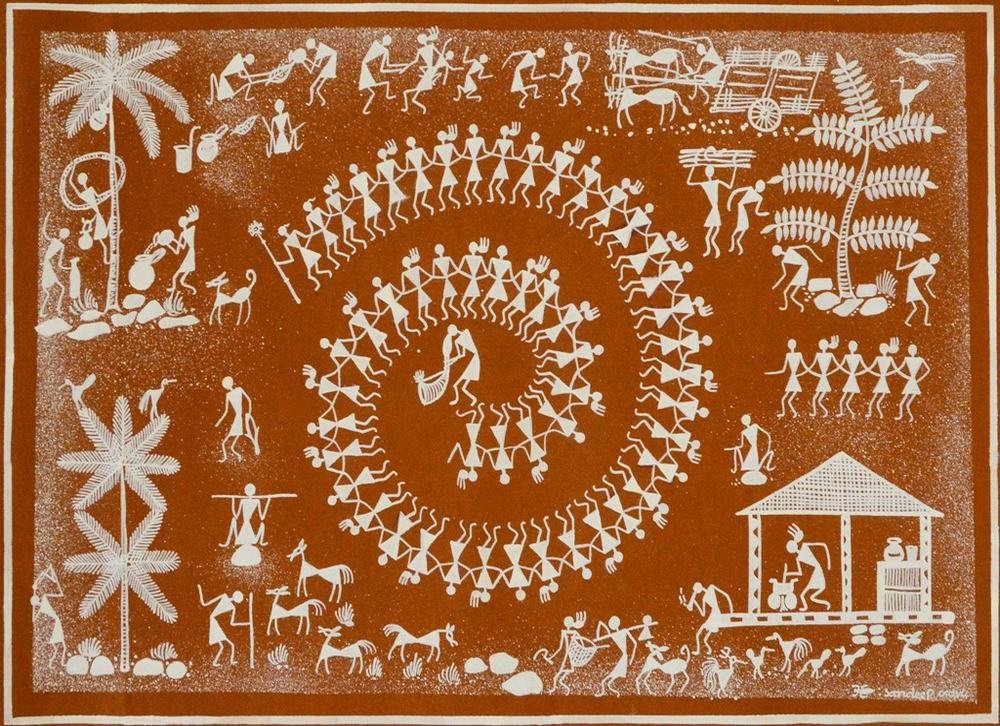
The majority of the tribal artists that produce Warli paintings are from Maharashtra, India's North Sahyadri Range. Warli painting began in Maharashtra, where it is being practiced today, and is found in cities like Dahanu, Talasari, Jawhar, Palghar, and Mokhada. The paintings are typically applied on mud walls using a white pigment that is created by mixing rice paste with water. They use straightforward geometric designs to represent everyday life, farming operations, animals, and natural components. Women have always produced Warli art, which is frequently associated with festivals and ceremonies. The idea of Mother Nature is central to Warli culture, and Warli paintings frequently feature natural themes as main features. They use straightforward geometric designs to represent everyday life, farming operations, animals, and natural components. Women have always produced Warli art, which is frequently associated with festivals and ceremonies.

Warli paintings at Sanskriti Kendra Museum, Anandagram, New Delhi
One of the best examples of the folk style of painting is the Warli painting tradition in Maharashtra. The Warli tribe, which resides outside of Mumbai, is among the biggest in India. Although the tribal style of art is believed to have originated as early as the 10th century C.E., it wasn't until the 1970s. Warli painting began in Maharashtra, where it is being practiced today, and is found in cities like Dahanu, Talasari, Jawhar, Palghar, and Mokhada. The paintings are typically applied on mud walls using a white pigment that is created by mixing rice paste with water. They use straightforward geometric designs to represent everyday life, farming operations, animals, and natural components. Women have always produced Warli art, which is frequently associated with festivals and ceremonies. The idea of Mother Nature is central to Warli culture, and Warli paintings frequently feature natural themes as main features. Their primary means of subsistence and a major source of sustenance for the tribe is farming. Because of the resources that nature and wildlife offer for life, they have a deep reverence for them.
Painting technique
These simple wall paintings use a collection of fundamental geometric shapes, such as squares, triangles, and circles, together with a color scheme that typically consists of white and brown. Several aspects of nature are represented by these shapes. Their observations of nature are the source of the triangle and circle. Warli painting began in Maharashtra, where it is being practiced today, and is found in cities like Dahanu, Talasari, Jawhar, Palghar, and Mokhada. The paintings are typically applied on mud walls using a white pigment that is created by mixing rice paste with water.They use straightforward geometric designs to represent everyday life, farming operations, animals, and natural components. Women have always produced Warli art, which is frequently associated with festivals and ceremonies. Mountains and conical trees are represented by the triangle, while the sun and moon are represented by the circle. The square, on the other hand, represents a piece of land or a sacred enclosure and is depicted as a human invention. The square, sometimes referred to as the "chauk" or "chaukat," is the focal point of every ceremonial painting. There are primarily two varieties of these paintings: Devchauk and Lagnachauk. A representation of Palghat, the mother goddess, who represents fraternity, is typically found inside a Devchauk.
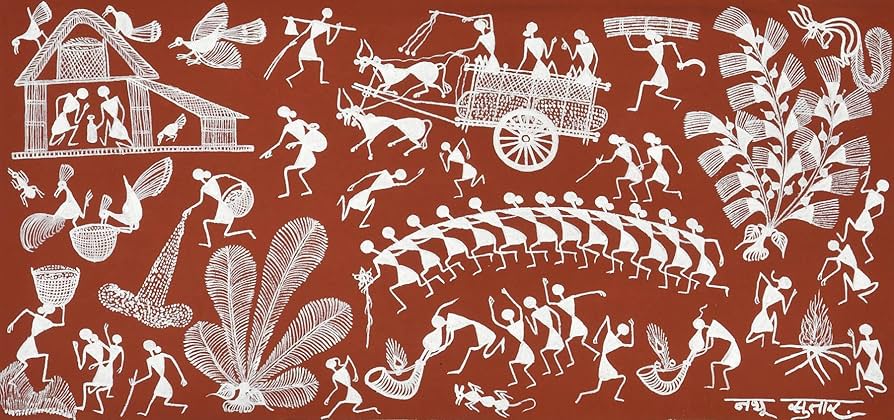
Among the Warli, male gods are uncommon and usually associated with spirits that have assumed human form. The ceremonial painting's main topic is encircled by scenes of farming, hunting, fishing, trees, and animals. Ritual paintings frequently feature scenes of festivals and dances. Two inverse triangles linked at their tips are used to symbolize people and animals; the bottom triangle represents the pelvis, and the upper triangle represents the torso. The balance of the universe is represented by their perilous equilibrium. Additionally, the representation has the humorous and useful benefit of animating the bodies.The representation of a triangle with a larger top, signifying a male, and a triangle with a broader bottom, signifying a lady, is another prevalent topic in Warli art. In addition to ritualistic paintings, other Warli paintings depicted the village residents' daily activities.
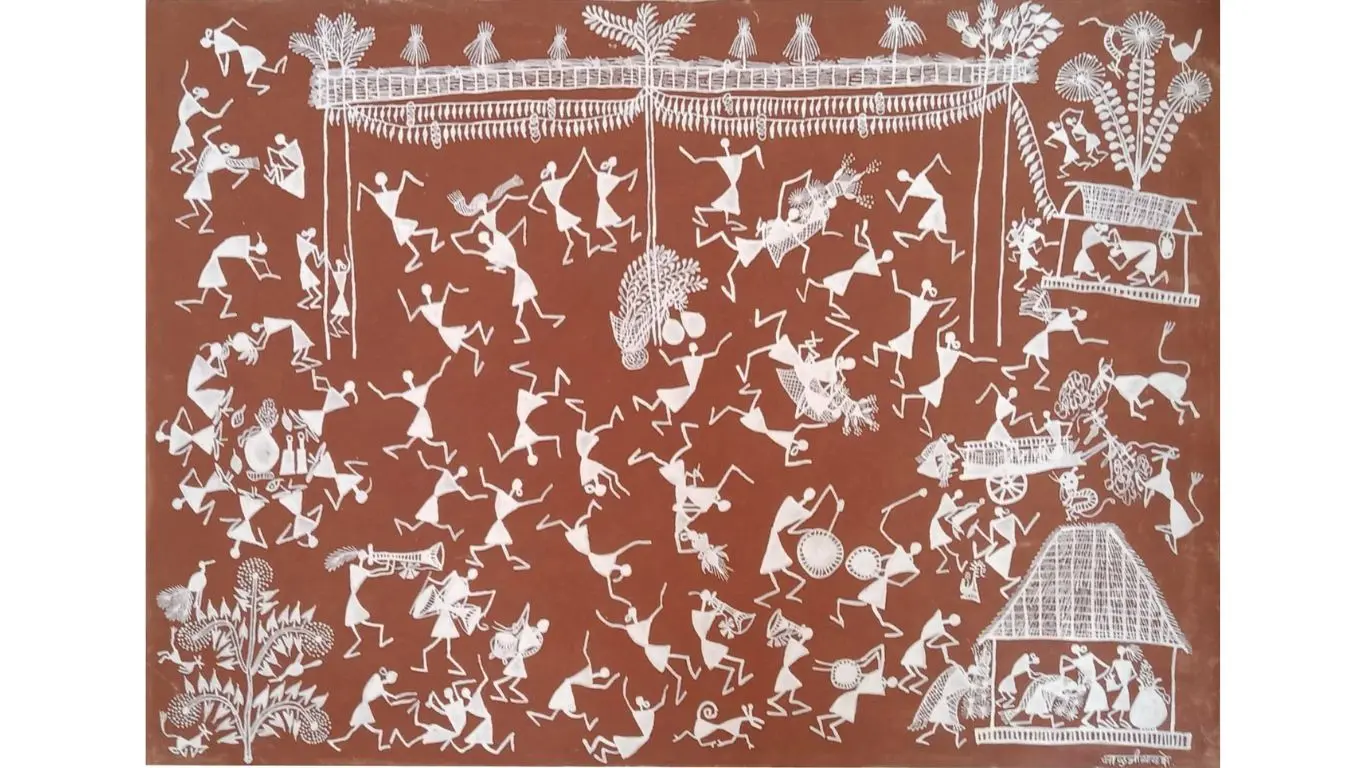
The tarpa dance is one of the main elements portrayed in numerous Warli paintings. Several village men take turns playing the tarpa, an instrument that resembles a trumpet. The tarpa player is surrounded by men and women who entwine their hands. The dancers then follow him, never looking away from the tarpa as they turn and move in tandem with him. The head dancer moves in either a clockwise or counterclockwise direction when the musician plays two distinct notes. They use straightforward geometric designs to represent everyday life, farming operations, animals, and natural components. Women have always produced Warli art, which is frequently associated with festivals and ceremonies. The idea of Mother Nature is central to Warli culture, and Warli paintings frequently feature natural themes as main features. The dancers take on the role of the symbolic snake, and the tarpa player plays a part akin to that of a snake charmer. For amusement, the dancers do a lengthy turn in front of the audience and attempt to surround them.
Materials used
Warli paintings have a basic technique that corresponds with their plain pictorial language. The interior walls of village huts are typically where the ritual paintings are made. In order to create a red ochre backdrop for the paintings, the walls are composed of a combination of branches, dirt, and red brick. They use straightforward geometric designs to represent everyday life, farming operations, animals, and natural components. Women have always produced Warli art, which is frequently associated with festivals and ceremonies. The idea of Mother Nature is central to Warli culture, and Warli paintings frequently feature natural themes as main features. Gum is used as a binder and rice flour and water are combined to create the white pigment used in Warli paint. At the end, a bamboo stick is chewed to give it a paintbrush-like texture. Walls are only painted to commemorate important events like festivals, weddings, and harvests. They create it with the understanding that it will be visible to future generations.
In contemporary culture
The traditional tribal sense of style for their paintings is explained by the absence of regular artistic activity. When Jivya Soma Mashe and his son Balu Mashe began painting in the 1970s, this ceremonial art underwent a dramatic change. Warli painting began in Maharashtra, where it is being practiced today, and is found in cities like Dahanu, Talasari, Jawhar, Palghar, and Mokhada. The paintings are typically applied on mud walls using a white pigment that is created by mixing rice paste with water. They use straightforward geometric designs to represent everyday life, farming operations, animals, and natural components. Women have always produced Warli art, which is frequently associated with festivals and ceremonies. They painted as a result of their artistic endeavors rather than for ceremonial motives. Jivya is regarded as the founder of contemporary Warli painting. Warli paintings have been transferred to paper and canvas since the 1970s.
In an effort to showcase the ancient culture and symbolize unity, Coca-Cola India started a campaign that used Warli paintings. "Come Home on Deepawali" was the name of the campaign, which was aimed at today's youngsters. In addition to radio, the Internet, and out-of-home media, the campaign featured advertising on conventional mass media.

The Manik Public School in Maniknagar, Karnataka, displayed India's largest Warli art painting on a sizable wall of their academic building in an effort to conserve Indian heritage. Warli painting began in Maharashtra, where it is being practiced today, and is found in cities like Dahanu, Talasari, Jawhar, Palghar, and Mokhada. The paintings are typically applied on mud walls using a white pigment that is created by mixing rice paste with water. They use straightforward geometric designs to represent everyday life, farming operations, animals, and natural components. They use straightforward geometric designs to represent everyday life, farming operations, animals, and natural components. Women have always produced Warli art, which is frequently associated with festivals and ceremonies. The idea of Mother Nature is central to Warli culture, and Warli paintings frequently feature natural themes as main features. Women have always produced Warli art, which is frequently associated with festivals and ceremonies. The school's vision, beliefs, and activities were created and painted by renowned Warli artist Avanti Sandeep Kulkarni using Warli themes and culture. Warli customs were highlighted in sections of the paintings. The record was acknowledged in the India Book of Records.
Traditional knowledge and intellectual property
Warli painting is a form of cultural intellectual property and traditional knowledge that has been passed down through the generations. Warli painting began in Maharashtra, where it is being practiced today, and is found in cities like Dahanu, Talasari, Jawhar, Palghar, and Mokhada. The paintings are typically applied on mud walls using a white pigment that is created by mixing rice paste with water. They use straightforward geometric designs to represent everyday life, farming operations, animals, and natural components. Women have always produced Warli art, which is frequently associated with festivals and ceremonies. The tribal non-governmental group Adivasi Yuva Seva Sangh assisted in registering Warli paintings with a geographical designation under the intellectual property rights statute because they recognized the pressing need for intellectual property rights. Numerous initiatives are underway to bolster the Warli's sustainable economy through social entrepreneurship.
Join our classes to enhance & improve your memory skills and let your child unlock the power to retain information from every moment of his/her life!
